Affiliate Disclosure: As an Amazon Associate we earn from qualifying purchases. Some links may earn us a commission at no cost to you.

Best 32-Inch 4K Gaming Monitors (2026): 5 Picks by Budget
A 32-inch 4K panel puts roughly 140 pixels per inch in front of you, against about 109 on a 27-inch 1440p screen. That density is the real reason to step up a size, and it is what makes small text and distant game geometry resolve instead of shimmer.
The harder question is whether your graphics card can feed it. Every pick below names the GPU class that drives it at its rated refresh, because the best 32 inch 4K gaming monitor for you is the one your card can keep up with.
Our top pick: ASUS ROG XG32UCWMG
The ASUS ROG XG32UCWMG wins on the spec that decides whether HDR survives a lit room. It peaks at 1,300 nits on a small window, the highest figure of any 32-inch OLED here, and it does that behind a glossy coating that keeps contrast intact rather than washing it into grey.

Quick picks
Pick | Monitor | Panel and refresh | Best for | Buy |
|---|---|---|---|---|
Best Overall | Glossy WOLED, 240 Hz | HDR in a room with windows | ||
Best Value | QD-OLED, 240 Hz | 4K at 240 Hz for the least outlay | ||
Best Premium | Curved QD-OLED, 240 Hz | A shared PC and console desk | ||
Best Budget | Curved SS VA, 144 Hz | Pixel density without the OLED tax | ||
Editor's Pick | WOLED, 240 Hz or 1080p at 480 Hz | Ranked shooters and story games |
Best Overall
- Monitor
- Panel and refresh
Glossy WOLED, 240 Hz
- Best for
HDR in a room with windows
- Buy
Best Value
- Monitor
- Panel and refresh
QD-OLED, 240 Hz
- Best for
4K at 240 Hz for the least outlay
- Buy
Best Premium
- Monitor
- Panel and refresh
Curved QD-OLED, 240 Hz
- Best for
A shared PC and console desk
- Buy
Best Budget
- Monitor
- Panel and refresh
Curved SS VA, 144 Hz
- Best for
Pixel density without the OLED tax
- Buy
Editor's Pick
- Monitor
- Panel and refresh
WOLED, 240 Hz or 1080p at 480 Hz
- Best for
Ranked shooters and story games
- Buy
Specs at a glance
Monitor | Panel | Refresh | Peak HDR | Ports | GPU class to drive it |
|---|---|---|---|---|---|
31.5in glossy WOLED | 240 Hz | 1,300 nits | DP 1.4 DSC, 2x HDMI 2.1, USB-C | RTX 5070 Ti and up; RTX 5080 class near 240 Hz | |
31.5in QD-OLED | 240 Hz | About 1,000 nits | DP 1.4a, HDMI 2.1, USB-C 90 W | RTX 5070 Ti or RX 9070 XT and up | |
31.6in curved QD-OLED | 240 Hz | 1,000 nits, Dolby Vision | 2x HDMI 2.1 eARC, DP 1.4 DSC | RTX 5080 class on PC; PS5 at 4K 120 Hz | |
31.5in curved SS VA | 144 Hz, 160 Hz OC | DisplayHDR 400 | DP 1.4, 2x HDMI 2.1, USB-C | RTX 5070 or RX 9070 class | |
31.5in WOLED | 240 Hz, 480 Hz at 1080p | Up to 1,500 nits | DP 2.1 UHBR13.5, 2x HDMI 2.1, USB-C | RTX 5080 class for the 4K mode |
- Panel
31.5in glossy WOLED
- Refresh
240 Hz
- Peak HDR
1,300 nits
- Ports
DP 1.4 DSC, 2x HDMI 2.1, USB-C
- GPU class to drive it
RTX 5070 Ti and up; RTX 5080 class near 240 Hz
- Panel
31.5in QD-OLED
- Refresh
240 Hz
- Peak HDR
About 1,000 nits
- Ports
DP 1.4a, HDMI 2.1, USB-C 90 W
- GPU class to drive it
RTX 5070 Ti or RX 9070 XT and up
- Panel
31.6in curved QD-OLED
- Refresh
240 Hz
- Peak HDR
1,000 nits, Dolby Vision
- Ports
2x HDMI 2.1 eARC, DP 1.4 DSC
- GPU class to drive it
RTX 5080 class on PC; PS5 at 4K 120 Hz
- Panel
31.5in curved SS VA
- Refresh
144 Hz, 160 Hz OC
- Peak HDR
DisplayHDR 400
- Ports
DP 1.4, 2x HDMI 2.1, USB-C
- GPU class to drive it
RTX 5070 or RX 9070 class
- Panel
31.5in WOLED
- Refresh
240 Hz, 480 Hz at 1080p
- Peak HDR
Up to 1,500 nits
- Ports
DP 2.1 UHBR13.5, 2x HDMI 2.1, USB-C
- GPU class to drive it
RTX 5080 class for the 4K mode
How we picked these 32-inch 4K gaming monitors
Pixel density comes first. At 31.5 inches, 4K lands near 138 to 140 PPI. The same size at 1440p sits closer to 93, and a 27-inch 1440p screen is around 109. A useful working band for a desktop panel is roughly 100 to 150 PPI, which is exactly where 32-inch 4K falls. That is also why going bigger at 1440p is a step backwards, and why the question of whether 1440p is still enough resolves differently at this size.
Bandwidth comes second, and this is where the spec sheets get slippery. Uncompressed 4K at 240 Hz needs roughly 63 Gbps of display bandwidth. DisplayPort 2.1a at UHBR20 supplies close to 80 Gbps usable and clears it outright. UHBR13.5 tops out near 54 Gbps and does not.
So four of the five picks here run Display Stream Compression at 240 Hz, including the one with a DisplayPort 2.1 port on the back. DSC is visually lossless in practice and nobody should lose sleep over it. The point is narrower: a DisplayPort 2.1 badge is a version number, not a bandwidth claim, and the UHBR tier underneath it is the spec that matters.
GPU class comes third. RTX 50-series cards output DisplayPort 2.1a at UHBR20; RTX 40-series cards are DisplayPort 1.4 only and reach 4K 240 Hz through compression. For frames rather than ports, feeding 4K at high refresh in current titles starts around the RTX 5070 Ti or RX 9070 XT tier. Whether a 5070 Ti clears 4K depends heavily on the games you play, and our 4K GPU picks go through that tier by tier.
Frame generation changes what is reachable, not what the card is. It turns 60 into 120, and it does not turn 30 into 120. A 240 Hz figure built from multi-frame generation on a 60 fps base is a 60 fps card with arithmetic attached, and in a competitive title you will feel the added latency before you notice the smoothness. Compare native or quality-upscaled numbers between cards first, then add frame generation on top mentally.
Panel technology is the last split, and it is mostly a room-lighting decision. QD-OLED gives the deepest blacks and the widest color volume, at the cost of a triangular subpixel layout that fringes small text and raised blacks under ambient light. Glossy WOLED holds contrast better in a lit room and renders type more cleanly. VA gives up response time and off-angle uniformity but carries no burn-in clock at all. Every OLED here sits in the 240 to 335 nit band for full-field SDR, so a south-facing desk is a real argument for the VA pick, and the wider question of whether an OLED panel is worth it is worth settling before you spend.
Best Overall: ASUS ROG XG32UCWMG
Specs
Panel | 31.5in glossy WOLED |
Resolution | 3840 x 2160 (about 140 PPI) |
Refresh rate | 240 Hz |
Response time | 0.03 ms GtG |
HDR peak | 1,300 nits (3% window) |
Color | 99% DCI-P3 |
Ports | DP 1.4 with DSC, 2x HDMI 2.1 FRL, USB-C DP Alt Mode |
Adaptive sync | G-SYNC Compatible, FreeSync Premium Pro |
Panel
31.5in glossy WOLED
Resolution
3840 x 2160 (about 140 PPI)
Refresh rate
240 Hz
Response time
0.03 ms GtG
HDR peak
1,300 nits (3% window)
Color
99% DCI-P3
Ports
DP 1.4 with DSC, 2x HDMI 2.1 FRL, USB-C DP Alt Mode
Adaptive sync
G-SYNC Compatible, FreeSync Premium Pro
What it does well
The headline number is the peak HDR figure: 1,300 nits on a small window, measurably ahead of the QD-OLED picks in this group. In practice that shows up as specular highlights that read as bright, sun through a window in a driving game, muzzle flash in a dark corridor, rather than a slightly lifted grey.
The glossy coating is the other half of that story. Matte coatings scatter ambient light across the whole panel and lift black level everywhere; a glossy finish reflects it in defined spots you can position around. In a room with windows, glossy WOLED holds its contrast where a matte panel gives it up.
Two full HDMI 2.1 FRL ports mean a console and a PC both land natively, with no adapter and no bandwidth compromise. It also carries G-SYNC Compatible and FreeSync Premium Pro certification, so adaptive sync is settled whichever card you own.
What you give up
The WOLED subpixel layout is not an RGB stripe, and small text pays for it. Against the new RGB-stripe tandem panels arriving this generation, thin fonts show a faint color edge. For gaming it is a non-issue; for eight hours of spreadsheets it is the thing you would notice first.
Full-field SDR brightness is OLED-modest, as on every OLED here. The 1,300-nit figure is a small-window HDR measurement, not something the whole screen sustains, and reports suggest buyers expecting a bright-room desktop panel read it the wrong way.
DisplayPort 1.4 means 240 Hz arrives over DSC. Visually that is a non-event, but if you specifically wanted an uncompressed signal path, this is not the panel that provides one.
Who it's for
A single-desk buyer running one 4K panel for both games and work, on an RTX 5070 Ti or better, in a room that has windows and is not going to get blackout curtains.
Best Value: MSI MPG 321URX QD-OLED

Specs
Panel | 31.5in QD-OLED |
Resolution | 3840 x 2160 (about 140 PPI) |
Refresh rate | 240 Hz |
Response time | 0.03 ms GtG |
HDR | DisplayHDR True Black 400, about 1,000 nits peak |
SDR brightness | about 240 nits |
Ports | DP 1.4a, HDMI 2.1, USB-C with 90 W PD |
Panel care | OLED Care 2.0, graphene heatsink |
Panel
31.5in QD-OLED
Resolution
3840 x 2160 (about 140 PPI)
Refresh rate
240 Hz
Response time
0.03 ms GtG
HDR
DisplayHDR True Black 400, about 1,000 nits peak
SDR brightness
about 240 nits
Ports
DP 1.4a, HDMI 2.1, USB-C with 90 W PD
Panel care
OLED Care 2.0, graphene heatsink
What it does well
This is the cheapest genuine 4K 240 Hz OLED in the group, and the panel generation it uses is the one that set the reference point for the category. The refresh rate, the response time and the black level are the same class as picks costing considerably more.
USB-C with 90 W power delivery is the quiet win. One cable carries video and charges a laptop, which turns the monitor into a docking station for anyone who moves between a desktop and a work machine.
MSI's panel care has matured: taskbar detection, boundary protection and multi-logo dimming, backed by a graphene film and a custom heatsink to move heat off the emitter layer. None of that eliminates the burn-in clock, but it slows it down measurably.
What you give up
QD-OLED's triangular subpixel layout is the sharpest trade here. Buyers have flagged text fringing as the main daily-driver complaint on this panel type, and at 140 PPI you are close enough to see it on thin strokes.
Full-field SDR brightness is the lowest of the five, and QD-OLED raises black level under ambient light more visibly than WOLED does. A bright room pulls the panel's best quality out from under it.
There is one HDMI 2.1 port rather than two, so a console and a second source will compete for it.
Who it's for
The buyer who wants 4K at 240 Hz and will not pay a flagship premium for a brightness bump they cannot see in a dim room. If you already know you want the OLED class rather than the flagship, this is where the group's value sits.
Best Premium: Alienware AW3225QF

Specs
Panel | 31.6in QD-OLED, 1700R curve |
Resolution | 3840 x 2160 (about 140 PPI) |
Refresh rate | 240 Hz |
Response time | 0.03 ms GtG |
HDR | DisplayHDR True Black 400, Dolby Vision, 1,000 nits peak |
Ports | 2x HDMI 2.1 with VRR and eARC, DP 1.4 with DSC |
Console audio | Dolby Atmos eARC passthrough |
Warranty | 3-year, includes OLED burn-in coverage |
Panel
31.6in QD-OLED, 1700R curve
Resolution
3840 x 2160 (about 140 PPI)
Refresh rate
240 Hz
Response time
0.03 ms GtG
HDR
DisplayHDR True Black 400, Dolby Vision, 1,000 nits peak
Ports
2x HDMI 2.1 with VRR and eARC, DP 1.4 with DSC
Console audio
Dolby Atmos eARC passthrough
Warranty
3-year, includes OLED burn-in coverage
What it does well
This is the only pick here that treats console duty as a first-class case. Dolby Vision support, two full HDMI 2.1 ports with VRR, and eARC passthrough for Dolby Atmos to a soundbar mean a PS5 runs at 4K 120 Hz with its audio chain intact while a PC sits on DisplayPort at 240 Hz.
The warranty is the other reason it earns the premium slot. Three years of advanced exchange with OLED burn-in named in the coverage terms is worth more than any on-panel care feature, because it converts a probabilistic risk into someone else's problem.
The panel itself is third-generation QD-OLED at 240 Hz with near-instant response, so nothing about the gaming case is compromised to get the console feature set.
What you give up
The 1700R curve is a preference, not a feature, and at 32 inches it divides people more sharply than it does on an ultrawide. Straight lines in a spreadsheet or a CAD viewport bend, and that is the thing you cannot unsee once you have seen it.
It is the most expensive pick in the group, and the gap buys console features rather than gaming performance. If no console is ever going to touch this desk, you are paying for ports you will not use.
DisplayPort 1.4 still means DSC at 240 Hz, same as most of this group.
Who it's for
A shared desk where a PS5 and a PC both need to look their best, and where the owner would rather pay once for one panel that does both than compromise on either.
Best Budget: Gigabyte M32UC

Specs
Panel | 31.5in curved SS VA |
Resolution | 3840 x 2160 (about 140 PPI) |
Refresh rate | 144 Hz, 160 Hz overclocked |
Response time | 1 ms MPRT |
HDR | VESA DisplayHDR 400 |
Color | 90% DCI-P3 |
Ports | DP 1.4, 2x HDMI 2.1, USB-C |
Extras | Built-in KVM switch, 4x USB 3.2 |
Panel
31.5in curved SS VA
Resolution
3840 x 2160 (about 140 PPI)
Refresh rate
144 Hz, 160 Hz overclocked
Response time
1 ms MPRT
HDR
VESA DisplayHDR 400
Color
90% DCI-P3
Ports
DP 1.4, 2x HDMI 2.1, USB-C
Extras
Built-in KVM switch, 4x USB 3.2
What it does well
This pick skips the OLED question entirely and still lands 4K at 144 Hz for roughly half the outlay of the panels above it. There is no burn-in clock, no pixel-refresh routine to remember, and no reason to hide your taskbar.
SS VA contrast is well ahead of IPS at this tier, which matters more in dark games than any HDR label on the box. Two HDMI 2.1 ports handle console 4K 120 Hz, and the built-in KVM switch means a work laptop and a desktop can share one keyboard and mouse.
The refresh ceiling is also honest about the hardware most buyers own. If your card cannot feed 240 Hz at 4K, paying for 240 Hz buys a number rather than an experience, and the difference goes into the graphics card instead.
What you give up
Dark-scene smearing is the VA tax and it does not go away. Fast camera pans across shadowed geometry trail in a way no OLED here does, and the 1 ms figure is an MPRT number rather than a grey-to-grey one.
DisplayHDR 400 is a label, not an experience. Treat this as a good SDR panel and you will be happy; expect HDR and you will not.
The M32U and the M32UC are different panels, flat IPS against curved SS VA, and the model names differ by a single character. Buyers have landed on the wrong one. Check the product page says M32UC before you order.
Who it's for
A buyer stepping up to 4K on an RTX 5070 or RX 9070-class card who wants the pixel density now and would rather replace the panel in three years than overspend today. If 4K at 144 Hz is the target rather than a compromise, that tier is worth reading on its own.
Editor's Pick: LG UltraGear 32GX870A
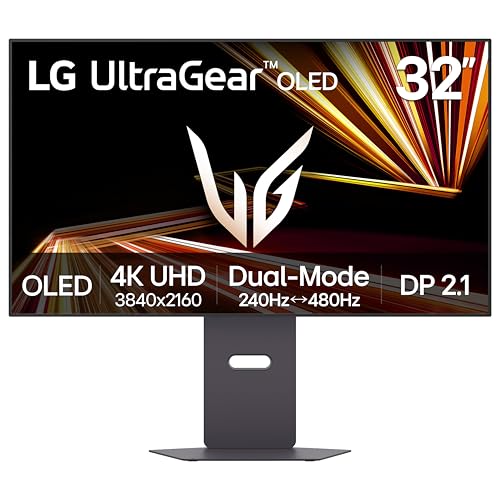
Specs
Panel | 31.5in WOLED |
Resolution | 3840 x 2160 (about 140 PPI) |
Refresh rate | 240 Hz, dual-mode 1080p at 480 Hz |
Response time | 0.03 ms GtG |
HDR | DisplayHDR True Black 400, up to 1,500 nits peak |
SDR brightness | up to 335 nits |
Color | 98.5% DCI-P3 |
Ports | DP 2.1 at UHBR13.5, 2x HDMI 2.1, USB-C |
Panel
31.5in WOLED
Resolution
3840 x 2160 (about 140 PPI)
Refresh rate
240 Hz, dual-mode 1080p at 480 Hz
Response time
0.03 ms GtG
HDR
DisplayHDR True Black 400, up to 1,500 nits peak
SDR brightness
up to 335 nits
Color
98.5% DCI-P3
Ports
DP 2.1 at UHBR13.5, 2x HDMI 2.1, USB-C
What it does well
One button turns a 4K 240 Hz cinema panel into a 1080p 480 Hz esports panel. That is not a marketing mode: the pixel clock genuinely changes, and in a ranked shooter the extra motion clarity is immediately legible.
It also posts the highest numbers in the group on both ends of the brightness question: up to 1,500 nits peak in HDR and up to 335 nits in SDR, which is the brightest full-field figure of the three OLED picks here.
It is the only panel in this roundup with DisplayPort 2.1 at all, alongside two HDMI 2.1 ports and USB-C, which makes it the most future-proof connector set of the five.
What you give up
1080p stretched across 31.5 inches is coarse. The 480 Hz mode is a competitive tool you switch into for a session, not a resolution you would sit in all evening, and anyone expecting it to look like a native 1080p 24-inch panel will be disappointed.
Its DisplayPort 2.1 runs at UHBR13.5, roughly 54 Gbps, which is below the 63 Gbps that uncompressed 4K 240 Hz needs. So it still uses DSC, and the newer port number does not buy what the badge implies.
It carries a price premium over the value pick for a dual-mode feature that only pays off if you genuinely play both kinds of game.
Who it's for
A buyer who splits their evenings between ranked shooters and story games, refuses to run two monitors, and would rather press a button than accept a compromise in either direction. If you only ever play one of those two ways, the rest of the 4K 240 Hz OLED group is a better fit.
Bottom line
If you want one 4K panel for games and work and your room has windows, buy the ASUS ROG XG32UCWMG. If you want 4K at 240 Hz for the least outlay, the MSI MPG 321URX QD-OLED is where the value sits. If a PS5 and a PC share the desk, the Alienware AW3225QF is the only pick here with Dolby Vision and two full HDMI 2.1 ports. If your graphics card cannot feed 240 Hz yet, the Gigabyte M32UC gets you the pixel density now with no burn-in clock to manage. And if your evenings split between ranked shooters and story games, the LG UltraGear 32GX870A switches modes instead of asking you to choose.
Whichever way you go, size the panel to the card you own, not the card you plan to buy. The broader framework for pairing a display to a GPU covers the rest of that decision.
FAQ
Is a 32-inch 4K monitor worth it for gaming?
Yes, if you have a graphics card in the RTX 5070 class or better and you play story-driven or open-world games. At roughly 140 PPI the sharpness gain over 1440p is visible at a normal desk distance rather than a spec-sheet abstraction.
If you live in ranked shooters and care about frame rate ceiling above everything else, 4K is the wrong target and a 1440p panel at a higher refresh serves you better. The honest split is about your library, not your budget.
What GPU do you need for a 32-inch 4K 240Hz monitor?
For 4K at high refresh in current titles, start at an RTX 5070 Ti or an RX 9070 XT. For 4K near 240 Hz in demanding games you are in RTX 5080 territory, and even an RTX 5090 does not hold 240 fps natively in the heaviest titles without multi-frame generation.
There is a port dimension too. Only RTX 50-series cards output DisplayPort 2.1a at UHBR20. A 40-series card can still run 4K at 240 Hz, but over DisplayPort 1.4 with compression.
Is 32 inches too big for 4K at a normal desk distance?
No. A good working range for desktop pixel density is roughly 100 to 150 PPI, and 32-inch 4K lands near 138. At a viewing distance of about 60 to 75 cm you get the extra detail without leaning in, and without the scaling awkwardness that 4K at 27 inches creates.
The real constraint is desk depth rather than panel size. If your screen sits closer than about 50 cm, a 32-inch panel starts asking you to move your head to track the corners.
How long before an OLED gaming monitor shows burn-in?
Reports put a modern OLED monitor at roughly three to five years of mixed use before visible burn-in, longer if you leave the panel-care features on and let the pixel-refresh cycles run.
The risk concentrates in static elements: taskbars, game HUDs, stream overlays, a spreadsheet grid left open all day. Every OLED pick here ships some form of logo and taskbar detection to dim those regions. The Alienware is the one that names burn-in in its warranty terms, which is worth more than any care feature.
QD-OLED or WOLED at 32 inches: which should you pick?
Pick QD-OLED if your room is dim and you want the widest color volume and the deepest blacks. Pick glossy WOLED if your room has windows and you read a lot of text, because that subpixel layout renders small type more cleanly and holds contrast better under ambient light.
The gap is narrower than either camp claims. Both land the same near-instant pixel response, and both sit in the same modest full-field SDR brightness band.
Do you need DisplayPort 2.1 for 4K at 240Hz?
No, and the badge alone does not settle it. Uncompressed 4K at 240 Hz needs roughly 63 Gbps. DisplayPort 2.1a at UHBR20 supplies close to 80 Gbps and clears it; UHBR13.5 tops out near 54 Gbps and falls back to Display Stream Compression, the same as DisplayPort 1.4.
DSC is visually lossless in practice, so most buyers will never see the difference. Check which UHBR tier a monitor's DisplayPort 2.1 port actually runs at rather than trusting the version number.
Related Articles

Best 4K Gaming Monitor 2026: 5 OLED, Mini-LED and IPS Picks
Best 4K gaming monitor picks for 2026: OLED, Mini-LED and IPS compared from 144Hz to 240Hz, with the GPU each tier needs and a budget IPS entry point.
Aug 16, 2026

Best 4K 240Hz OLED Gaming Monitors 2026: 6 Picks Compared
The best 4K 240Hz OLED gaming monitors, ranked: which 27 and 32 inch QD-OLED and WOLED panels are worth buying, and which RTX 5090 pairing needs DP 2.1a.
Sep 13, 2026

Best GPUs for 4K Gaming (2026): Picks by Refresh Target
Five GPUs for 4K gaming in 2026, segmented by refresh target and workload: the 5080 buy zone, the AMD-vs-Nvidia call by tier, why the 5090 is usually wrong.
May 21, 2026

Is an OLED Gaming Monitor Worth It in 2026? Burn-In, 3 Picks
An OLED gaming monitor is worth it at 1440p or higher in a dim room. Where the price crossover lands, the burn-in risk in 2026, and when Mini-LED wins.
Aug 25, 2026

Will an RTX 5090 Fit in a Corsair 4000D? Yes (2026)
Will an RTX 5090 fit in a Corsair 4000D? Yes in all three cases, but the 360mm Airflow only clears cards under 360mm and wants an angled 12V-2x6 cable.
Sep 29, 2026