Affiliate Disclosure: As an Amazon Associate we earn from qualifying purchases. Some links may earn us a commission at no cost to you.

Best Gaming Monitors for the RTX 5070 Ti (2026): 5 Picks
The RTX 5070 Ti settles most of the resolution argument the moment you look at its native frame rates. Across a fifteen game suite it averages around 140 fps at 1440p. At 4K the same kind of suite drops to roughly 97 fps before any upscaling, and the heaviest titles fall much further than that.
So the panel question is not which OLED is trending this month. It is which resolution and refresh this card can feed on its own, and whether its DisplayPort 2.1b output changes the answer. Five picks below, tiered by what the card genuinely drives.
Our top pick: LG UltraGear 27GS95QE
The LG UltraGear 27GS95QE sits exactly on this card's raster budget. It runs 1440p at 240 Hz, with OLED response fast enough that those frames read as 240 rather than as a smear.

Quick picks
Pick | Monitor | Best for | Buy |
|---|---|---|---|
Best Overall | 1440p 240 Hz, mixed library | ||
Best Value | 1440p 300 Hz, esports leaning | ||
Best Premium | 4K 240 Hz over DisplayPort 2.1 | ||
Best Budget | 1440p 180 Hz on a tight budget | ||
Editor's Pick | 34 inch ultrawide immersion |
Best Overall
- Monitor
- Best for
1440p 240 Hz, mixed library
- Buy
Best Value
- Monitor
- Best for
1440p 300 Hz, esports leaning
- Buy
Best Premium
- Monitor
- Best for
4K 240 Hz over DisplayPort 2.1
- Buy
Best Budget
- Monitor
- Best for
1440p 180 Hz on a tight budget
- Buy
Editor's Pick
- Monitor
- Best for
34 inch ultrawide immersion
- Buy
Specs at a glance
Monitor | Size and panel | Resolution | Refresh | HDR | Display input |
|---|---|---|---|---|---|
27 inch WOLED | 2560 x 1440 | 240 Hz | True Black 400 | DisplayPort 1.4 | |
27 inch Fast IPS | 2560 x 1440 | 300 Hz | None meaningful | DisplayPort 1.4 | |
26.5 inch Tandem QD-OLED | 3840 x 2160 | 240 Hz | True Black 400, Dolby Vision | DisplayPort 2.1a UHBR20 | |
27 inch IPS | 2560 x 1440 | 180 Hz (200 Hz OC) | HDR10 badge only | DisplayPort 1.4 | |
34 inch curved QD-OLED | 3440 x 1440 | 240 Hz | True Black 400 | DisplayPort 1.4a |
- Size and panel
27 inch WOLED
- Resolution
2560 x 1440
- Refresh
240 Hz
- HDR
True Black 400
- Display input
DisplayPort 1.4
- Size and panel
27 inch Fast IPS
- Resolution
2560 x 1440
- Refresh
300 Hz
- HDR
None meaningful
- Display input
DisplayPort 1.4
- Size and panel
26.5 inch Tandem QD-OLED
- Resolution
3840 x 2160
- Refresh
240 Hz
- HDR
True Black 400, Dolby Vision
- Display input
DisplayPort 2.1a UHBR20
- Size and panel
27 inch IPS
- Resolution
2560 x 1440
- Refresh
180 Hz (200 Hz OC)
- HDR
HDR10 badge only
- Display input
DisplayPort 1.4
- Size and panel
34 inch curved QD-OLED
- Resolution
3440 x 1440
- Refresh
240 Hz
- HDR
True Black 400
- Display input
DisplayPort 1.4a
Benchmarks
What the card renders at 2560 x 1440 before DLSS 4 or frame generation enter the picture.
- 140 FPS
- 125 FPS
- 80 FPS
- 410 FPS
The suite average clears 60, but the heaviest titles do not get there without upscaling.
- 97 FPS
- 145 FPS
- 31 FPS
How we paired these
Lock the graphics card first, then buy the panel it can feed. The 5070 Ti averages about 140 fps at 1440p native across a broad suite, which means a 1440p screen somewhere between 180 Hz and 240 Hz stays fed most of the time. Move to 4K and that suite average drops to about 97 fps. Alan Wake 2 lands near 31 fps at 4K with DLSS Quality already doing the lifting.
That is the line between upscaling as a feature and upscaling as a crutch. DLSS 4 Quality at 1440p costs you almost nothing visually. At 4K in a path traced scene it is carrying the frame rate on its back, and frame generation does not rescue it. Frame generation turns 60 into 120. It never turns 30 into 120. Below a 60 fps native base you feel the latency and you see the artifacts on fast camera motion.
Competitive players should switch frame generation off entirely, which is why refresh headroom on a natively fed panel is worth more than an interpolated number on a box. A 300 Hz IPS that the card saturates in Counter-Strike 2 beats a 4K panel showing interpolated frames, if that is the library you live in.
Blackwell is the first consumer generation to carry DisplayPort 2.1b at the full UHBR20 rate, which is 80 Gbps of link bandwidth. That matters for exactly one panel class: 4K at 240 Hz, where UHBR20 delivers the mode without display stream compression. Every 1440p panel here, including the 240 Hz OLED and the 3440 x 1440 ultrawide, fits inside DisplayPort 1.4 with DSC and loses nothing you can see. Reports also suggest that not every board partner card exposes the full UHBR20 rate, so check the specification sheet for your exact model before buying a panel on that basis.
One more thing, said plainly. The monitor is the most under defended line item in a 2026 build. Buyers who agonize over a graphics card will pair it with whatever cheap panel is on sale, and the display is the part they stare at every single day. If the budget covers peripherals, defend the screen before anything else. For the wider framework, read how to choose a GPU and a matching display. If you are still deciding between cards, the step up from the RTX 5070 covers that call.
Best Overall: LG UltraGear 27GS95QE
Specs
Panel | 27-inch WOLED |
Resolution | 2560 x 1440 |
Refresh rate | 240 Hz |
Response time | 0.03 ms GtG |
HDR | DisplayHDR True Black 400 |
Adaptive sync | G-Sync Compatible, FreeSync Premium Pro |
Inputs | HDMI 2.1, DisplayPort 1.4 |
Panel
27-inch WOLED
Resolution
2560 x 1440
Refresh rate
240 Hz
Response time
0.03 ms GtG
HDR
DisplayHDR True Black 400
Adaptive sync
G-Sync Compatible, FreeSync Premium Pro
Inputs
HDMI 2.1, DisplayPort 1.4
What it does well
Motion is the reason to buy this panel. A 0.03 ms transition strips out the smear a 240 Hz IPS still carries at the same refresh, and you notice it the first time you flick the camera. Per pixel blacks handle the rest in dark scenes, where an IPS lifts everything into grey.
The 240 Hz ceiling is not decoration here. Counter-Strike 2 clears 400 fps at 1440p on this card, and most modern single player titles reach the panel's sync range with DLSS 4 Quality switched on. The 27GS95QE's 0.03 ms panel is the part doing the work you can see.
G-Sync Compatible certification means variable refresh works without a tuning session, and the HDMI 2.1 inputs let a console share the screen at full rate.
What you give up
WOLED uses a subpixel layout that softens small text. Gaming is untouched by this. Spreadsheets and code look faintly fringed next to an IPS, which matters if this is also your work monitor.
Sustained fullscreen brightness is modest, so a bright room dulls HDR highlights. Burn in mitigation is part of ownership: pixel refresh cycles, screen shift, and no static HUD parked on it for eight hours. The input is DisplayPort 1.4, so none of the card's UHBR20 bandwidth gets used. At 1440p 240 Hz that costs you nothing.
Who it's for
One monitor, mixed library, 1440p. If you play a bit of everything and want the screen to be good at all of it rather than excellent at one thing, this is the pairing.
Best Value: ASUS TUF Gaming VG27AQM5A

Specs
Panel | 27-inch Fast IPS |
Resolution | 2560 x 1440 |
Refresh rate | 300 Hz |
Response time | 0.3 ms GtG |
Color | 95% DCI-P3 |
Motion handling | ELMB Sync, Shadow Boost |
Panel
27-inch Fast IPS
Resolution
2560 x 1440
Refresh rate
300 Hz
Response time
0.3 ms GtG
Color
95% DCI-P3
Motion handling
ELMB Sync, Shadow Boost
What it does well
300 Hz is the only refresh figure in this list the 5070 Ti can genuinely saturate. Counter-Strike 2 runs past 400 fps at 1440p, Valorant and Overwatch sit comfortably above 300, and this panel takes every frame the card sends. ELMB Sync keeps backlight strobing available alongside adaptive sync, which tightens motion further in fast titles.
Fast IPS at 0.3 ms lands close enough to OLED in motion that most buyers stop noticing after a week. Color coverage of 95% DCI-P3 is honest for the tier, and the three year warranty runs longer than most panels near this price.
What you give up
Contrast. IPS blacks read grey in a dark room and no firmware setting fixes that. The HDR badge is nominal without local dimming, so leave it off and enjoy a well calibrated SDR image instead.
The second trade is that most of the refresh sits idle. Nothing in a modern AAA title reaches 300 fps natively on this card. You are buying headroom for the competitive half of your library and accepting that the single player half never touches it.
Who it's for
The player who spends four evenings a week in a shooter and the fifth in a campaign. Refresh first, contrast second.
Best Premium: ASUS ROG Swift PG27UCDM
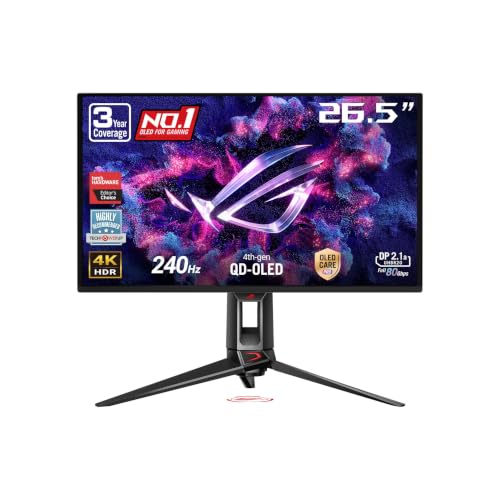
Specs
Panel | 26.5-inch Tandem QD-OLED |
Resolution | 3840 x 2160 |
Refresh rate | 240 Hz |
Response time | 0.03 ms GtG |
HDR | DisplayHDR 400 True Black, Dolby Vision |
Video inputs | DisplayPort 2.1a UHBR20, HDMI 2.1 |
USB-C | 90 W power delivery |
Panel
26.5-inch Tandem QD-OLED
Resolution
3840 x 2160
Refresh rate
240 Hz
Response time
0.03 ms GtG
HDR
DisplayHDR 400 True Black, Dolby Vision
Video inputs
DisplayPort 2.1a UHBR20, HDMI 2.1
USB-C
90 W power delivery
What it does well
This is the one pairing that uses the card's DisplayPort 2.1b output for its intended purpose. UHBR20 carries 80 Gbps, which is enough for 4K at 240 Hz with no display stream compression anywhere in the chain.
Tandem QD-OLED lifts sustained brightness over the first generation of QD-OLED panels, which is what made those earlier screens frustrating in a lit room. Dolby Vision and DisplayHDR 400 True Black make HDR single player content the reason to own it. Dropping to 1440p for competitive play works cleanly, and the 90 W USB-C input handles a laptop on the side.
What you give up
Honesty first. Native 4K in heavy titles is a sub 60 proposition on this card. The suite average clears 97 fps, but Alan Wake 2 sits near 31 fps at 4K even with DLSS Quality enabled. DLSS 4 is doing real work here rather than adding polish, and our verdict on whether the card is enough for 4K goes deeper on where that line falls.
The panel also costs more than the graphics card feeding it, which inverts the usual build order. And 4K on a 26.5 inch diagonal needs display scaling, which a handful of older games still handle badly.
Who it's for
The buyer who wants one screen for HDR single player at 4K and upscaled competitive at high refresh, and who is comfortable spending more on the display than on the GPU.
Best Budget: LG UltraGear 27GS75Q-B

Specs
Panel | 27-inch IPS |
Resolution | 2560 x 1440 |
Refresh rate | 180 Hz (200 Hz overclock) |
Response time | 1 ms GtG |
HDR | HDR10, no local dimming |
Stand | Tilt, height, pivot |
Panel
27-inch IPS
Resolution
2560 x 1440
Refresh rate
180 Hz (200 Hz overclock)
Response time
1 ms GtG
HDR
HDR10, no local dimming
Stand
Tilt, height, pivot
What it does well
180 Hz at 1440p still sits above what this card averages in most modern single player titles, so nothing about the GPU goes to waste. That is the whole argument for this screen. It is the cheapest panel that does not hold a 5070 Ti back.
Full height, tilt and pivot adjustment is unusual at this tier and matters more day to day than any number on the box. G-Sync Compatible certification means variable refresh works the moment you plug it in.
What you give up
An HDR10 label with no backlight behind it. Leave HDR switched off. IPS glow shows in dark scenes, and the 200 Hz mode is an overclock toggle buried in the on screen menu rather than the default state.
The bigger trade is esports headroom. Your card can push past 400 fps in Counter-Strike 2 and this panel will show you 180 of them. That is the money you saved, made visible.
Who it's for
The buyer whose budget went almost entirely into the graphics card. If you are cross shopping the tier below, the RTX 5070 monitor list covers the same panel classes against a slower card.
Editor's Pick: MSI MPG 341CQPX QD-OLED

Specs
Panel | 34-inch curved QD-OLED (1800R) |
Resolution | 3440 x 1440 (21:9) |
Refresh rate | 240 Hz |
Response time | 0.03 ms GtG |
HDR | DisplayHDR 400 True Black |
Color | 99.3% DCI-P3, Delta E under 2 |
Inputs | DisplayPort 1.4a, HDMI 2.1, USB-C 98 W |
Panel
34-inch curved QD-OLED (1800R)
Resolution
3440 x 1440 (21:9)
Refresh rate
240 Hz
Response time
0.03 ms GtG
HDR
DisplayHDR 400 True Black
Color
99.3% DCI-P3, Delta E under 2
Inputs
DisplayPort 1.4a, HDMI 2.1, USB-C 98 W
What it does well
3440 x 1440 is roughly a third more pixels than standard 1440p, which lands inside this card's raster budget rather than outside it. Ultrawide immersion arrives without a DLSS dependency, and that is rarer than it sounds at this GPU tier.
QD-OLED color volume is the strongest in this list, with 99.3% DCI-P3 coverage and factory Delta E under 2. The MSI's 98 W USB-C input turns it into a single cable dock on the days you are not gaming.
What you give up
DisplayPort 1.4a means display stream compression carries the 240 Hz signal. In practice that is invisible, but it does leave the card's UHBR20 output unused, so do not buy this panel for the DisplayPort 2.1 story.
Ultrawide support is still inconsistent in a few competitive shooters, where the aspect ratio is either unsupported or letterboxed. The 1800R curve divides opinion for desktop work, and QD-OLED blacks lift under bright room lighting.
Who it's for
Single player and simulation buyers who want field of view over refresh ceiling. If that is you, the extra width is the upgrade you feel every session.
Bottom line
If you want one panel that is good at everything, buy the LG UltraGear 27GS95QE. If your library leans competitive, the ASUS TUF Gaming VG27AQM5A gives you refresh this card can fill. If you want 4K at 240 Hz over an uncompressed link, the ASUS ROG Swift PG27UCDM is the only pick here that does it. If the GPU ate the budget, the LG UltraGear 27GS75Q-B still clears the card's frame rates. And if width beats refresh for you, the MSI MPG 341CQPX QD-OLED is the widest screen this card feeds natively.
Whichever you pick, size the rest of the build around it. The CPU side of the same pairing and the power supply for the same build are both worth a look before you order.
FAQ
Is the RTX 5070 Ti a 1440p card or a 4K card?
It is a 1440p card that reaches 4K with help. Across a broad game suite it averages around 140 fps at 1440p native and about 97 fps at 4K, and the heaviest ray traced titles fall well below 60 at 4K even with DLSS Quality enabled. Buy it for 1440p at high refresh, and treat 4K as a resolution you can visit with upscaling rather than one you live at natively.
Can the RTX 5070 Ti drive a 4K 240Hz monitor?
It drives the signal without trouble, because Blackwell supports DisplayPort 2.1b at the full UHBR20 rate. Whether it fills 240 frames at 4K is a separate question. In esports titles it gets close. In modern single player games you are looking at 60 to 100 fps with DLSS 4, plus frame generation on top if the base rate is already above 60.
Do you need DisplayPort 2.1 for the RTX 5070 Ti?
Only if you are buying a 4K 240 Hz panel, where UHBR20 delivers that mode without display stream compression. Every 1440p screen in this list, including the 240 Hz OLED and the 3440 x 1440 ultrawide, runs happily on DisplayPort 1.4 with DSC and loses nothing visible. Check the specification sheet for your specific board partner card, since reports suggest not every model exposes the full UHBR20 rate.
Is a 240Hz monitor overkill for an RTX 5070 Ti?
No, though it depends which games you count. Counter-Strike 2 runs past 400 fps at 1440p on this card, so 240 Hz is undersubscribed there. Cyberpunk 2077 at Ultra without ray tracing sits near 125 fps, which is comfortably inside a 240 Hz adaptive sync range. You get the benefit in competitive play and headroom everywhere else.
Should you get an OLED or an IPS monitor for the RTX 5070 Ti?
OLED if the room is dim and the library is mixed, because per pixel blacks and near instant response are the two things IPS cannot match. IPS if the monitor doubles as a work screen, if the room is bright, or if the money is better spent elsewhere in the build. A 300 Hz Fast IPS also gives you more usable refresh for competitive play than a 240 Hz OLED does.
Can the RTX 5070 Ti handle a 3440 x 1440 ultrawide?
Yes, comfortably. Ultrawide 1440p is about a third more pixels than standard 1440p, which keeps it inside the card's native raster budget in most titles. Expect roughly 100 to 110 fps in demanding single player games at high settings, and far more than that in esports. The real trade is aspect ratio support, which a few competitive shooters still handle poorly.
Related Articles

Is the RTX 5070 Ti Enough for 4K, or Need a 5080? (2026)
Is the RTX 5070 Ti enough for 4K? It clears most games at 60fps with DLSS Quality, but the 5080 buys headroom for ray tracing and 120Hz targets. Verdict inside.
Aug 1, 2026

Best CPUs for the RTX 5070 Ti (2026): 5 Picks by Tier
The best CPU for an RTX 5070 Ti depends on your resolution. Five picks from budget AM5 to 16-core flagship, plus the bottleneck math for 1080p, 1440p and 4K.
Aug 11, 2026

RTX 5070 vs 5070 Ti (2026): 12 GB or 16 GB, Which Wins?
RTX 5070 vs RTX 5070 Ti: does 16 GB and 46% more cores reach your screen at 1440p or 4K? The up-tier call, answered row by row instead of by one average.
Sep 25, 2026

Best Gaming Monitors for the RTX 5070 (2026): 1440p to 4K OLED
Five monitors paired to the RTX 5070 by resolution tier: 1440p 240Hz IPS, 4K OLED, and ultrawide. Includes DLSS 4 reality check and pairing framework.
Jun 3, 2026

How to Choose a GPU (and a Monitor That Matches)
A buyer's framework for picking a GPU and the monitor that pairs with it. Start with the panel and work the card back.
May 17, 2026