Affiliate Disclosure: As an Amazon Associate we earn from qualifying purchases. Some links may earn us a commission at no cost to you.

Best GPU for Ryzen 5 7600 (2026): 5 Picks by Monitor Tier
The best GPU for a Ryzen 5 7600 depends on your monitor first. The 7600 is a 6-core, 12-thread Zen 4 chip on AM5 with a 65 W TDP, and it keeps a mid-range card fed at 1440p with almost nothing lost. Pair it with a flagship at 1080p, though, and the CPU sets the frame rate long before the card does.
So these picks go by monitor tier and stop where more GPU stops paying off on six Zen 4 cores. Every pick carries at least 12 GB of VRAM, and none of them is an RTX 5080 or 5090.
Our top pick: ASRock Challenger RX 9070 OC
The ASRock Challenger RX 9070 OC is the card we would put in most 7600 builds: 16 GB of VRAM, 220 W of board power, and a GPU the 7600 barely holds back at 1440p.

Quick picks
Pick | Graphics card | Best for | Buy |
|---|---|---|---|
Best Overall | 1440p at 144 Hz and up | ||
Best Value | 1080p high refresh | ||
Best Premium | 1440p ultra and entry 4K | ||
Best Budget | Entry 1080p on a tight budget | ||
Editor's Pick | Streaming and DLSS at 1080p or 1440p |
Best Overall
- Graphics card
- Best for
1440p at 144 Hz and up
- Buy
Best Value
- Graphics card
- Best for
1080p high refresh
- Buy
Best Premium
- Graphics card
- Best for
1440p ultra and entry 4K
- Buy
Best Budget
- Graphics card
- Best for
Entry 1080p on a tight budget
- Buy
Editor's Pick
- Graphics card
- Best for
Streaming and DLSS at 1080p or 1440p
- Buy
Specs at a glance
Graphics card | VRAM | Board power | PCIe link | Monitor tier |
|---|---|---|---|---|
16 GB GDDR6 | 220 W | 5.0 x16 | 1440p high refresh | |
16 GB GDDR6 | 160 W | 5.0 x16 | 1080p high refresh | |
16 GB GDDR6 | 304 W | 5.0 x16 | 1440p ultra, entry 4K | |
12 GB GDDR6 | 190 W | 4.0 x8 | 1080p | |
16 GB GDDR7 | 180 W | 5.0 x8 | 1080p and 1440p |
- VRAM
16 GB GDDR6
- Board power
220 W
- PCIe link
5.0 x16
- Monitor tier
1440p high refresh
- VRAM
16 GB GDDR6
- Board power
160 W
- PCIe link
5.0 x16
- Monitor tier
1080p high refresh
- VRAM
16 GB GDDR6
- Board power
304 W
- PCIe link
5.0 x16
- Monitor tier
1440p ultra, entry 4K
- VRAM
12 GB GDDR6
- Board power
190 W
- PCIe link
4.0 x8
- Monitor tier
1080p
- VRAM
16 GB GDDR7
- Board power
180 W
- PCIe link
5.0 x8
- Monitor tier
1080p and 1440p
Benchmarks
How much faster a 9800X3D ran than a 7600X with each graphics card. The smaller the number, the less a six-core Zen 4 chip holds that card back.
- 37 %
- 20 %
- 8 %
- 5 %
Relative raster performance from TechSpot's RX 9070 review.
- 100 %
- 92 %
Native rendering, no upscaling or frame generation.
- 131 FPS
- 69 FPS
The first chart is the one that matters for this CPU. TechSpot ran a Ryzen 7 9800X3D and a Ryzen 5 7600X with four graphics cards: with an RTX 5090 the X3D chip pulled 37% ahead at 1080p medium, but with an RX 9070 the gap shrank to 8%, and with an RX 9060 XT to 5%. The non-X 7600 trails the 7600X by a few percent in games, so treat those gaps as close proxies. The other two charts come from a fast test CPU and show GPU ceilings. We did not find same-rig data for the Arc B580 against these cards, so it sits out of the charts. If you have not picked a monitor yet, our guide to how to choose a GPU and monitor matches resolution and refresh rate to a card tier.
How we picked a GPU for the Ryzen 5 7600
We lock the GPU first and size it to the point where the CPU becomes the limit. The scaling data above draws that line. With a mid-range Radeon, a 9800X3D beats a 7600X by single digits at 1080p and 1440p. With an RTX 5080 the gap jumps to 20% at 1080p medium, and with an RTX 5090 to 37%. Spend past the RX 9070 XT tier on this chip and a growing share of the money goes to frames the CPU cannot deliver. If you are weighing a CPU upgrade instead, our take on whether the 7600 is enough or a 7800X3D is worth it runs the numbers.
VRAM is the second filter. Four of five picks carry 16 GB and the floor is 12 GB. An 8 GB card at this tier runs out of texture memory within a year or two, and no driver update fixes that.
Third, the platform. Most B650 boards run the main slot at PCIe 4.0 x16, which costs the x16 Radeons nothing measurable. The two x8 cards here lose little at this performance tier, but it is one more reason to check what your board offers. If you are still choosing one, our board picks for the Ryzen 5 7600 all carry a full-length x16 slot.
Last, power and budget balance. The 7600 is a 65 W chip that often ships as the cheapest part of an AM5 build, so the picks favor cards that run on one or two standard 8-pin plugs and a mid-size power supply. If you want an RTX 5080 class card, the GPU picks for the 7800X3D pair it with a CPU that can keep up.
Best Overall: ASRock Challenger RX 9070 OC
Specs
Chip | Radeon RX 9070 (RDNA 4, 56 CUs) |
VRAM | 16 GB GDDR6, 256-bit |
Boost clock | Up to 2520 MHz |
Board power | 220 W |
Power connectors | 2x 8-pin PCIe |
Interface | PCIe 5.0 x16 |
Cooler | Triple fan, 0 dB idle mode |
Chip
Radeon RX 9070 (RDNA 4, 56 CUs)
VRAM
16 GB GDDR6, 256-bit
Boost clock
Up to 2520 MHz
Board power
220 W
Power connectors
2x 8-pin PCIe
Interface
PCIe 5.0 x16
Cooler
Triple fan, 0 dB idle mode
What it does well
The RX 9070 is where a 7600 build stays balanced. In TechSpot's scaling test, a 9800X3D ran only 7% ahead of a 7600X with this card at 1440p medium, and 3% at 1440p ultra. In plain terms, the six-core chip lets you keep nearly everything the card can do.
Sixteen gigabytes on a 256-bit bus keeps 1440p ultra textures comfortable for years. FSR 4 Quality mode holds up well at 1440p, so you have a real upscaling option when a heavy game needs it.
The 220 W board power is the quiet win. The Challenger runs three fans, stops them at idle, and a quality 700 W power supply covers it with room to spare.
What you give up
The RX 9070 XT is about 8% faster at 1440p across TechSpot's 18-game average, and ray tracing trails Nvidia in path-traced titles. If your library leans on Cyberpunk path tracing or Alan Wake 2, this is not the card for it.
Watch the price gap. Some RX 9070 listings have drifted to RX 9070 XT money, and at parity the Best Premium pick is the better buy. Our RX 9070 vs RX 9070 XT comparison covers where that line sits. The Challenger is also a plain card: no RGB worth mentioning and a roughly 290 mm length that most mid-towers swallow.
Who it's for
Buy it if you game on a 1440p monitor at 144 to 180 Hz, play mostly raster AAA and shooters, and want the 7600 to stay out of the way.
Best Value: ASRock Challenger RX 9060 XT OC (16 GB)

Specs
Chip | Radeon RX 9060 XT (RDNA 4, 32 CUs) |
VRAM | 16 GB GDDR6, 128-bit |
Boost clock | Up to 3290 MHz |
Board power | 160 W |
Power connector | 1x 8-pin PCIe |
Interface | PCIe 5.0 x16 |
Length | About 249 mm, dual fan |
Chip
Radeon RX 9060 XT (RDNA 4, 32 CUs)
VRAM
16 GB GDDR6, 128-bit
Boost clock
Up to 3290 MHz
Board power
160 W
Power connector
1x 8-pin PCIe
Interface
PCIe 5.0 x16
Length
About 249 mm, dual fan
What it does well
This is the cheapest card we would pair with a 7600, and the pairing is about as clean as it gets. TechSpot measured a 9800X3D only 5% ahead of a 7600X with an RX 9060 XT at 1080p medium, so a faster CPU buys you almost nothing here.
At 1080p it drives a high-refresh monitor in most current games, and the 16 GB pool means texture settings never become the bottleneck. Board power is 160 W on a single 8-pin plug, so a 550 W unit covers it.
The Challenger is short at about 249 mm, which makes it an easy fit in compact cases.
What you give up
The 128-bit memory bus shows at 1440p ultra, and ray tracing is a clear step down from the RX 9070. If you plan to move to a 1440p high-refresh monitor soon, our look at whether the RX 9060 XT is enough or you need a 9070 is worth a read before you buy.
Buyers have flagged that the 8 GB RX 9060 XT shares the name. Confirm you are on the 16 GB Challenger listing before you check out; the 8 GB card is the one we warn people away from.
Who it's for
Buy it if you play on a 1080p monitor at 144 to 165 Hz and want the whole 7600 build to stay affordable.
Best Premium: PowerColor Hellhound RX 9070 XT

Specs
Chip | Radeon RX 9070 XT (RDNA 4, 64 CUs) |
VRAM | 16 GB GDDR6, 256-bit |
Boost clock | Up to 3010 MHz (OC mode) |
Board power | 304 W |
Power connectors | 2x 8-pin PCIe |
Interface | PCIe 5.0 x16 |
Length | About 340 mm with bracket |
Chip
Radeon RX 9070 XT (RDNA 4, 64 CUs)
VRAM
16 GB GDDR6, 256-bit
Boost clock
Up to 3010 MHz (OC mode)
Board power
304 W
Power connectors
2x 8-pin PCIe
Interface
PCIe 5.0 x16
Length
About 340 mm with bracket
What it does well
The RX 9070 XT is the ceiling we recommend for this CPU. TechSpot measured 131 fps in Cyberpunk 2077: Phantom Liberty at 1440p ultra, native, and its 18-game 1440p average had the card about 6% behind the RTX 5070 Ti.
At 1440p ultra and at 4K, the GPU does most of the work, so the 7600 stays out of the way. It is also the card to buy if you plan to drop a faster AM5 chip into the same board later, since the extra headroom carries over.
The Hellhound runs a factory boost of up to 3010 MHz on three fans and draws power through two standard 8-pin plugs, with no 12V-2x6 adapter involved.
What you give up
At 1080p medium in CPU-heavy games, the 7600 caps this card before it reaches its limit, so a 1080p player pays for frames they will not see. Ray tracing still trails Nvidia in path-traced titles.
Board power is 304 W, so plan on a quality 750 W unit; our PSU picks for RX 9070 builds cover the safe options. The card runs about 340 mm with its bracket, so check your case clearance before you order.
Who it's for
Buy it if you game on a 1440p 240 Hz monitor or a 4K screen and want the most GPU a 7600 can use. For more options at the top resolution, see our best GPUs for 4K gaming.
Best Budget: Sparkle Arc B580 Titan OC
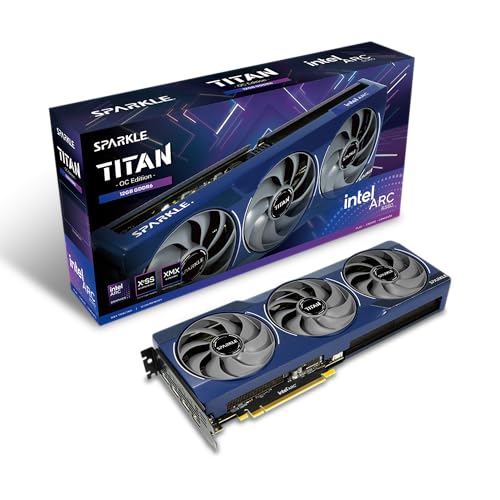
Specs
Chip | Intel Arc B580 (Battlemage, 20 Xe cores) |
VRAM | 12 GB GDDR6, 192-bit |
Board power | 190 W (Intel reference) |
Interface | PCIe 4.0 x8 |
Cooler | Torn Cooling 2.0, metal backplate |
Upscaling | XeSS 2 with frame generation |
Chip
Intel Arc B580 (Battlemage, 20 Xe cores)
VRAM
12 GB GDDR6, 192-bit
Board power
190 W (Intel reference)
Interface
PCIe 4.0 x8
Cooler
Torn Cooling 2.0, metal backplate
Upscaling
XeSS 2 with frame generation
What it does well
The Arc B580 is the floor for a new-card 7600 build. Its 12 GB of VRAM beats every 8 GB card in its class, and that matters more each year as games push texture budgets up.
Arc cards earned a reputation for driver overhead on slower CPUs. TechSpot's retest found the B580 lost almost nothing on a Ryzen 5 5600 against a 9800X3D in Rainbow Six Siege and Borderlands 4, and the 7600 is a faster chip than the 5600. Reports suggest Zen 4 sidesteps most of the problem; the steep losses showed up on much older CPUs like the Ryzen 5 2600.
XeSS 2 runs well on Intel's own hardware, and AV1 encode is there for recording and streaming.
What you give up
Older DX11 titles can still be uneven on Arc drivers. This is a 1080p card, not a 1440p ultra card; our look at whether the Arc B580 is enough for 1440p covers where it runs short. It uses a PCIe 4.0 x8 link, which is fine on AM5, and stock tends to come and go.
Who it's for
Buy it if you are building a first PC around a 1080p 144 Hz monitor and every dollar counts.
Editor's Pick: ASUS Prime RTX 5060 Ti OC (16 GB)

Specs
Chip | GeForce RTX 5060 Ti (Blackwell) |
VRAM | 16 GB GDDR7, 128-bit |
Board power | 180 W |
Power connector | 1x 8-pin PCIe |
Interface | PCIe 5.0 x8 |
Encoder | NVENC with AV1 |
Chip
GeForce RTX 5060 Ti (Blackwell)
VRAM
16 GB GDDR7, 128-bit
Board power
180 W
Power connector
1x 8-pin PCIe
Interface
PCIe 5.0 x8
Encoder
NVENC with AV1
What it does well
This is the Nvidia pick for 7600 builders who stream or lean on DLSS 4. NVENC with AV1 is still the cleanest way to stream from a single PC, and DLSS 4 Quality mode at 1440p is close to native image quality.
It carries 16 GB, which is the whole point. It draws 180 W through one 8-pin plug, and a 7600 never limits it at 1080p or 1440p. The Prime is a compact card that suits small cases.
What you give up
Raster speed sits closer to the RX 9060 XT than to the RX 9070. TechSpot measured 69 fps in Cyberpunk 2077: Phantom Liberty at 1440p ultra against the RX 9070 XT's 131, so on pure frame rate the Radeons win.
Street pricing on the 16 GB RTX 5060 Ti has drifted up toward RX 9070 money; check the live price before you buy it on value grounds. Avoid the 8 GB RTX 5060 Ti, which shares the name. If you are on the faster Zen 5 chip instead, our GPU picks for the Ryzen 5 9600X make the same call.
Who it's for
Buy it if you stream, record with NVENC, or play DLSS-heavy games at 1080p or 1440p.
Bottom line
If you play at 1440p, buy the ASRock Challenger RX 9070 OC; the 7600 barely holds it back. If you play at 1080p, buy the ASRock Challenger RX 9060 XT OC (16 GB) and spend the difference elsewhere. If you want 1440p ultra or 4K, the PowerColor Hellhound RX 9070 XT is the ceiling for this chip. If money is tight, the Sparkle Arc B580 Titan OC is the floor. If you stream or want DLSS, buy the ASUS Prime RTX 5060 Ti OC (16 GB).
FAQ
Will the Ryzen 5 7600 bottleneck an RX 9070 XT?
At 1440p and 4K, mostly no. The RX 9070 XT does the heavy lifting there, and the 7600 lets it run close to full speed. At 1080p in CPU-heavy games, the six cores cap frame rates before the card does, so a 1080p player gets more value from the RX 9060 XT 16GB or the RX 9070. TechSpot's scaling data showed a 9800X3D only 3 to 8% ahead of a 7600X with an RX 9070, which is the tier where this chip is most comfortable.
Is the RTX 5070 a good GPU for the Ryzen 5 7600?
It pairs fine on performance, but we skip it. The RTX 5070 has 12 GB of VRAM in a price band where the RX 9070 offers 16 GB and similar or faster raster. If you want Nvidia for DLSS or NVENC on a 7600, the RTX 5060 Ti 16GB keeps the VRAM at 16 GB. If you want raw frame rate at 1440p, the RX 9070 or RX 9070 XT is the better buy.
What is the best GPU for a Ryzen 5 7600 at 1440p?
The RX 9070 is our pick. It has 16 GB of VRAM, draws 220 W, and in TechSpot's scaling test a 9800X3D was only 3 to 7% ahead of a 7600X with it at 1440p. If you run a 240 Hz panel or ultra settings in heavy games, step up to the RX 9070 XT. If you stream, the RTX 5060 Ti 16GB trades raw speed for NVENC and DLSS.
What PSU do I need for a Ryzen 5 7600 and RX 9070 XT?
A quality 750 W unit is the comfortable choice. The RX 9070 XT draws about 304 W and the 7600 is a 65 W chip, so the system sits well under that, but a 750 W supply gives headroom for transient spikes and future upgrades. A good 650 W ATX 3.1 unit can run the pair, though there is less margin. For the RX 9070, plan on about 700 W, and for the RX 9060 XT, 550 W is enough, in line with the board makers' guidance.
Should I pair a Ryzen 5 7600 with an RTX 5080?
Only if you play at 4K. At 4K the RTX 5080 does the work and the 7600 keeps up, but at 1080p medium TechSpot measured a 9800X3D 20% ahead of a 7600X with that card, so much of what you pay for goes unused. For high refresh rates at 1080p or 1440p, an RX 9070 XT on the 7600 is the better balance, or move up to an X3D chip first.
Does the Ryzen 5 7600 need a PCIe 5.0 graphics card?
No. Every pick here runs fine on PCIe 4.0, which is what the main slot on most B650 boards provides. The x16 Radeon cards lose nothing measurable on a 4.0 slot. The RTX 5060 Ti and Arc B580 use x8 links, which cost a little more on PCIe 4.0 but stay within a few percent at this tier. Buy for VRAM and performance, not the PCIe generation.
Related Articles

Best Motherboard for Ryzen 5 7600 (2026): 5 B650/B850 Picks
The best motherboard for a Ryzen 5 7600 is not the one with the biggest VRM. Five B650 and B850 picks ranked by form factor, networking, and M.2 count.
Sep 8, 2026

Is a Ryzen 5 7600 Enough? 7800X3D Costs 2x for 24% (2026)
Is the Ryzen 5 7600 enough for gaming in 2026? For most builds yes, and the 7800X3D costs roughly 2x for about 24% more frames. Here is when to step up.
Sep 25, 2026

Best GPU for Ryzen 5 9600X (2026): 5 Picks by Monitor Tier
The best GPU for Ryzen 5 9600X builds, picked by monitor tier: RX 9070 XT for 1440p, RX 9060 XT for 1080p, and where a 6-core Zen 5 chip stops scaling.
Oct 10, 2026

RX 9070 vs RX 9070 XT: Which RDNA 4 Card Wins in 2026
RX 9070 vs RX 9070 XT: the AMD-internal RDNA 4 call, decided by your 1440p panel ceiling, ray-tracing tolerance, and the efficiency vs raw-power tradeoff.
May 17, 2026

Best GPU for 1440p Gaming 2026: 5 16GB Picks, 144-240Hz
The best GPU for 1440p gaming in 2026: five 16GB picks matched to 144 and 240 Hz targets, the 8GB cards to skip, and the benchmarks behind every call.
Sep 26, 2026