Affiliate Disclosure: As an Amazon Associate we earn from qualifying purchases. Some links may earn us a commission at no cost to you.

Is 550W Enough for an RTX 5060? NVIDIA Says Yes (2026)
Yes. A quality 550W power supply is enough for an RTX 5060, and that is NVIDIA's own number: its RTX 5060 specification lists 550W as the required system power, sized against a 16-core Ryzen 9 9950X. The card is rated at 145W of total graphics power, so a full system built around a six or eight core chip peaks between roughly 290W and 380W. That is 53% to 69% of a 550W unit, the efficient middle of its load curve.
The one pairing that makes it tight is a 253W-class Intel K chip. A 14700K or 14900K beside the same card peaks near 455W, about 83% of a 550W unit. It runs, but only on a good supply. And if you are buying a supply today rather than reusing one, buy 650W, because the good ATX 3.1 platforms start there now.
At a glance
Power supply | Wattage | Standard | Best for | Buy |
|---|---|---|---|---|
650W | ATX 3.1, PCIe 5.1 | Buying new for any RTX 5060 build | ||
650W | ATX 3.1, PCIe 5.1 | In-house OEM, compact 140mm body | ||
750W | ATX 3.1, PCIe 5.1 | A bigger graphics card already planned |
- Wattage
650W
- Standard
ATX 3.1, PCIe 5.1
- Best for
Buying new for any RTX 5060 build
- Buy
- Wattage
650W
- Standard
ATX 3.1, PCIe 5.1
- Best for
In-house OEM, compact 140mm body
- Buy
- Wattage
750W
- Standard
ATX 3.1, PCIe 5.1
- Best for
A bigger graphics card already planned
- Buy
Verdict by CPU: is 550W enough for an RTX 5060?
Your CPU | Peak system draw | Load on 550W | Verdict | If you are buying new |
|---|---|---|---|---|
Ryzen 5 7600 or 9600X class | Around 290W | 53% | Yes, comfortably | |
Ryzen 7 9800X3D class | Around 365W | 66% | Yes | |
Core i5-14600K class | Around 380W | 69% | Yes | |
Core i7-14700K or i9-14900K | Around 455W | 83% | Tight, only on a quality unit |
Ryzen 5 7600 or 9600X class
- Peak system draw
Around 290W
- Load on 550W
53%
- Verdict
Yes, comfortably
- If you are buying new
Ryzen 7 9800X3D class
- Peak system draw
Around 365W
- Load on 550W
66%
- Verdict
Yes
- If you are buying new
Core i5-14600K class
- Peak system draw
Around 380W
- Load on 550W
69%
- Verdict
Yes
- If you are buying new
Core i7-14700K or i9-14900K
- Peak system draw
Around 455W
- Load on 550W
83%
- Verdict
Tight, only on a quality unit
- If you are buying new
Three of those four rows are a clean yes, and the fourth is a yes with conditions. The RTX 5060 sits 35W below the 5060 Ti, so even the worst pairing here lands where the Ti lands with a Core i5. If your current supply is a Gold-rated 550W unit from a trusted OEM, keep it and spend the money on the card or the CPU.
Three things flip that answer. The first is the 253W Intel K chip in the last row under a heavy all-core load, on a supply that is old or budget-grade. The second is a graphics card upgrade you have already committed to: a 5070 Ti or 5080 sits in the 300W to 360W class and takes the same system past 550W with any CPU. The third is the unit itself. A bronze supply from an unknown OEM is a risk at any wattage, and the PSU is the one part that can take the rest of the build with it when it fails.
How we sized it: RTX 5060 power draw
RTX 5060 at NVIDIA's 145W total graphics power, CPU at its rated package power ceiling, plus roughly 55W for board, memory, two NVMe drives and fans.
- Ryzen 5 7600 class290 watts
- Ryzen 7 9800X3D class365 watts
- Core i5-14600K class380 watts
- Core i7-14700K / i9-14900K class455 watts
NVIDIA's rated total graphics power for the RTX 5060 and the cards either side of it.
- RTX 5050130 watts
- RTX 5060145 watts
- RTX 5060 Ti180 watts
- RTX 5070250 watts
Start with the card. NVIDIA rates the RTX 5060 at 145W total graphics power and powers it from one 8-pin PCIe cable or a 300W-class PCIe Gen 5 cable through the adapter in the box. Like every Blackwell card it can overshoot that rating for a few milliseconds at a time, which is exactly the behaviour ATX 3.x supplies are specified to absorb. The same arithmetic for the RTX 5060 Ti starts from 180W, which is why that page reaches a stricter verdict than this one. For every RTX 50 card side by side, see our RTX 50 series PSU wattage chart.
Now add the CPU, because this is where builds separate. A Ryzen 5 7600 tops out near 88W of package power. A Ryzen 7 9800X3D runs to a 162W ceiling. A Core i5-14600K turbos to roughly 181W, and a Core i9-14900K is rated for 253W. Board, memory, two NVMe drives and a handful of fans add about 55W. Your chip choice swings the total by more than 160W, so the CPU decides this question far more than the graphics card does.
Those totals are ceilings, with every part at its limit at once. Games rarely load a CPU to its package ceiling, so real gaming draw sits below every bar in the first chart. NVIDIA's 550W figure already assumes a 16-core Ryzen 9, which is why it covers most builds with room left. If you are still choosing a processor, our CPU picks for the RTX 5060 sort the options by tier.
The 650W to buy new: be quiet! Pure Power 12 650W

Specs
Wattage | 650W |
Efficiency | 80 Plus Gold |
Standard | ATX 3.1, PCIe 5.1 |
12V-2x6 | Native cable |
Modularity | Non-modular, fixed cables |
PCIe leads | Two 6+2-pin |
Warranty | 10 years |
Wattage
650W
Efficiency
80 Plus Gold
Standard
ATX 3.1, PCIe 5.1
12V-2x6
Native cable
Modularity
Non-modular, fixed cables
PCIe leads
Two 6+2-pin
Warranty
10 years
What it does well
It is the cheapest unit we are happy to put under an RTX 5060 at any CPU tier, including the 14900K row that makes 550W tight. A 9800X3D build lands near 56% of its rating at peak, so it spends a gaming session in the quiet, efficient part of its curve.
It ships a native 12V-2x6 cable alongside two 6+2-pin PCIe leads. The 5060 itself takes an 8-pin, but the next card you buy may not, and a native cable beats the adapter in the box. Its ten-year warranty also runs three years longer than the Seasonic's below.
What you give up
The cables are fixed. Every lead stays attached whether you use it or not, so in a compact case the spare PCIe and drive cables have to be folded away somewhere, and that takes real cable management.
Check the letters before you check out. be quiet! sells a fully modular Pure Power 12 M next to this unit, and the two listings look alike. This one is the cabled version, which is why it costs less.
Who it's for
Anyone buying a supply for an RTX 5060 build today who wants the 650W answer at the lowest sensible spend. If the budget is tighter still, our list of cheap PSUs that are still safe covers the floor.
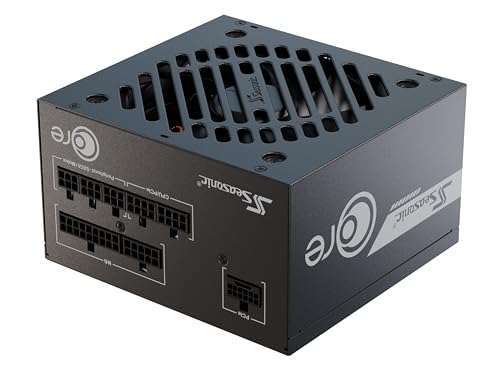
The 650W that closes the question: Seasonic CORE GX-650
Specs
Wattage | 650W |
Efficiency | 80 Plus Gold |
Standard | ATX 3.1, PCIe 5.1 |
12V-2x6 | Native, plus a 2x 8-pin adapter |
Modularity | Fully modular |
Fan | 120mm hydro dynamic bearing |
Depth | 140mm |
Warranty | 7 years |
Wattage
650W
Efficiency
80 Plus Gold
Standard
ATX 3.1, PCIe 5.1
12V-2x6
Native, plus a 2x 8-pin adapter
Modularity
Fully modular
Fan
120mm hydro dynamic bearing
Depth
140mm
Warranty
7 years
What it does well
Seasonic builds its own platforms, so the OEM question answers itself. On a power supply that matters more than in any other category, because the brand on the box tells you nothing about who assembled what is inside it.
The 140mm depth pays off in compact ATX cases, where a 160mm unit fouls the front intake fan or the cable bundle. It ships with a native 12V-2x6 cable, the reason we favour native ATX 3.1 units even for a card that only needs an 8-pin today.
What you give up
Seven years of warranty against ten on both other picks here, for a unit that costs about the same. Seasonic's coverage is real and its platforms rarely need it, but three years is three years.
You are also buying capacity you will not use. An RTX 5060 build leaves roughly half of this unit idle for its whole life. That keeps the fan quiet, but if a 300W-class card is genuinely coming, 650W is the wrong ceiling anyway.
Who it's for
The builder pairing an RTX 5060 with a Core i5-14600K or a 250W-class Intel K chip, or anyone working in a compact ATX case, who wants an in-house OEM and the power question closed for good.
Step up if a bigger card is coming: be quiet! Pure Power 13 M 750W

Specs
Wattage | 750W |
Efficiency | 80 Plus Gold, Cybenetics Gold |
Standard | ATX 3.1, PCIe 5.1 |
12V-2x6 | Native, rated 600W |
Modularity | Fully modular |
Fan | Semi-passive 120mm |
Rail | Single 12V |
Warranty | 10 years |
Wattage
750W
Efficiency
80 Plus Gold, Cybenetics Gold
Standard
ATX 3.1, PCIe 5.1
12V-2x6
Native, rated 600W
Modularity
Fully modular
Fan
Semi-passive 120mm
Rail
Single 12V
Warranty
10 years
What it does well
A Cybenetics Gold rating sits alongside the 80 Plus badge. Cybenetics measures efficiency and noise across the whole load curve rather than at three fixed points, so it tells you something the sticker does not.
The headroom is the point. 750W with a native 600W 12V-2x6 cable covers an RTX 5070 Ti, and a 5080 beside a Ryzen 7 class chip, which is a long upgrade path from a 5060 starting point. A single 12V rail removes the per-rail over-current guessing that trips people on multi-rail designs.
What you give up
You are buying 750W to run a system that peaks under 400W with a mainstream CPU. That capacity only earns its keep if the upgrade happens, and builders who say they will swap the card in two years often do not.
If the RTX 5060 is the card for the life of this build, this is overspend and the 650W picks above are the honest answer. Buy headroom only when you can name the card you are buying it for.
Who it's for
The builder treating the RTX 5060 as a stopgap with a specific next card picked out. If you are still weighing that decision, our RTX 5060 versus 5060 Ti comparison shows what the extra money buys in frames.
Bottom line
If you own a Gold-rated 550W unit from a trusted OEM and run a Ryzen 5, a Ryzen 7 or a Core i5, keep it: it is enough for an RTX 5060. If your chip is a 14700K or 14900K, make sure the supply is a quality unit, or move to 650W. If you are buying new, get the be quiet! Pure Power 12 650W. If you want an in-house OEM or a compact body, get the Seasonic CORE GX-650. If a 5070 Ti is already on your list, skip to the be quiet! Pure Power 13 M 750W.
If your supply is bronze, unbranded or older than you can remember, replace it whatever the label says. Our guide to judging a power supply beyond its wattage covers what to look for.
FAQ
Is 550W enough for an RTX 5060?
Yes, on a quality unit. NVIDIA lists 550W as the required system power for the RTX 5060, and that figure is sized for a 16-core Ryzen 9 9950X. A 145W card beside a Ryzen 5, Ryzen 7 or Core i5 peaks between about 290W and 380W, which is 53% to 69% of a 550W supply. Keep a Gold-rated 550W unit from a trusted OEM; replace a bronze or unbranded one.
Is 650W enough for an RTX 5060?
Yes, with plenty to spare. Even the heaviest pairing, a Core i9-14900K at its 253W ceiling, peaks near 455W, which is about 70% of a 650W unit. That is why 650W is our recommendation when you are buying new: it clears every CPU tier, and the good ATX 3.1 platforms start at 650W anyway. The be quiet! Pure Power 12 650W is the pick.
What PSU wattage does NVIDIA recommend for the RTX 5060?
550W. NVIDIA's RTX 5060 specification lists 550W as the required system power, based on a PC built around a Ryzen 9 9950X, and recommends a PCIe CEM 5.1 compliant supply. The card needs one 8-pin PCIe cable, or a 300W-class PCIe Gen 5 cable through the adapter in the box. Treat 550W as the floor for a good unit, not a ceiling.
How much power does the RTX 5060 draw?
NVIDIA rates the RTX 5060 at 145W of total graphics power, 35W less than the RTX 5060 Ti and 15W more than the RTX 5050. Real gaming draw usually sits at or under that rating, with brief spikes above it lasting milliseconds. Those spikes are what ATX 3.x supplies are specified to absorb, which is why the quality of the unit matters more than the last 50W of its label.
Will a 550W PSU shut down with an RTX 5060 and a Core i9?
On a quality unit, no, but it is the tightest case. A 14900K at its 253W ceiling plus the card and the platform peaks near 455W, about 83% of 550W. Shutdowns happen when combined spikes trip a supply's protection, and that needs a system already near its rating on a weak unit. If your 550W supply is old or budget-grade, move to a 650W ATX 3.1 unit.
Does the RTX 5060 need the same PSU as the RTX 5060 Ti?
No. The RTX 5060 is rated at 145W against the Ti's 180W, and NVIDIA's required system power is 550W against 600W for the Ti. That 35W gap is why a 550W unit clears every CPU tier here, while the Ti gets uncomfortable beside a 14700K or 14900K. Both cards use the same single 8-pin connector, so the cabling is identical.
Can I reuse an old 550W PSU with an RTX 5060?
Usually yes, after two checks. Age first: a unit past seven or eight years of daily use no longer delivers its rated output cleanly. Tier second: a Gold-rated 550W supply from Seasonic, Super Flower, CWT or FSP is fine for this card, while a bronze unit from an unknown OEM is a risk at any wattage. If either check fails, buy a 650W ATX 3.1 unit.
Related Articles

Is 550W Enough for an RTX 5060 Ti? The Real Math (2026)
Is 550W enough for an RTX 5060 Ti? We run the real wattage math by CPU tier, name the one pairing that breaks it, and pick the PSU worth buying in 2026.
Aug 23, 2026

Best Budget PSUs Under $80 (2026): 5 Cheapest Safe Picks
The best budget PSU under $80 still has a real safety floor. Five units that clear it, ranked by warranty length and ATX 3.1 support, plus what to skip.
Aug 15, 2026

Best ATX 3.1 Power Supplies (2026): 5 Native 12V-2x6 Picks
Five ATX 3.1 power supplies with native 12V-2x6 connectors, Cybenetics Gold through Platinum, all 850W, plus how to spot an ATX 3.0 unit sold with an adapter.
Aug 14, 2026

Best CPUs for the RTX 5060 (2026): 5 Picks by Tier
The RTX 5060 is a 1080p card, so the CPU only has to clear its frame ceiling. Five tiered CPU picks for an RTX 5060 build, plus the one tier you can skip.
Sep 15, 2026

Is the RTX 5060 Enough for 1080p? 8GB vs 5060 Ti 16GB (2026)
Is the RTX 5060 enough for 1080p? Yes for most games, with around 100fps in Hogwarts Legacy and Marvel Rivals. Here's when the 5060 Ti 16GB earns its price.
Oct 4, 2026