Affiliate Disclosure: As an Amazon Associate we earn from qualifying purchases. Some links may earn us a commission at no cost to you.

RTX 50 Series PSU Wattage: Chart for Every Card (2026)
Most RTX 50 series cards need less PSU wattage than the box suggests, provided the unit is a quality ATX 3.1 supply. NVIDIA's recommended system power runs from 550W for the RTX 5050 and RTX 5060 up to 1000W for the RTX 5090, and every one of those figures assumes a 16-core Ryzen 9 9950X sits next to the card.
Pair the card with a Ryzen 7 or Core Ultra 7 instead and the picture changes by tier. For the 5060 Ti and the 5080, a good unit one step under NVIDIA's figure is enough, and the 5090 joins them only in one narrow ATX 3.1 case. For the 5070 and 5070 Ti, NVIDIA's number is already the right one. The chart below gives every card, our verdict, and the full answer for each.
At a glance
Card | Board power | NVIDIA PSU | Our verdict | Full answer |
|---|---|---|---|---|
RTX 5050 | 130W | 550W | 550W with any mainstream CPU | Sizing steps below |
RTX 5060 | 145W | 550W | 550W is enough; tight only beside a 253W Intel K chip | |
RTX 5060 Ti | 180W | 600W | 550W with a Ryzen 5 or 7; 650W beside a 14700K or 14900K | |
RTX 5070 | 250W | 650W | 650W with a mainstream CPU; 750W for a Ryzen 9 or Core Ultra 9 | |
RTX 5070 Ti | 300W | 750W | 750W on a Ryzen 7 or Core Ultra 7; 850W for 16 cores or an overclock | |
RTX 5080 | 360W | 850W | 750W on ATX 3.1 with a Ryzen 7 class CPU; 850W with a Ryzen 9 or Core Ultra 9 | |
RTX 5090 | 575W | 1000W | 1000W for most builds; 850W only on ATX 3.1 beside a Ryzen 7; 1200W for a Core Ultra 9 |
RTX 5050
- Board power
130W
- NVIDIA PSU
550W
- Our verdict
550W with any mainstream CPU
- Full answer
Sizing steps below
RTX 5060
- Board power
145W
- NVIDIA PSU
550W
- Our verdict
550W is enough; tight only beside a 253W Intel K chip
- Full answer
RTX 5060 Ti
- Board power
180W
- NVIDIA PSU
600W
- Our verdict
550W with a Ryzen 5 or 7; 650W beside a 14700K or 14900K
- Full answer
RTX 5070
- Board power
250W
- NVIDIA PSU
650W
- Our verdict
650W with a mainstream CPU; 750W for a Ryzen 9 or Core Ultra 9
- Full answer
RTX 5070 Ti
- Board power
300W
- NVIDIA PSU
750W
- Our verdict
750W on a Ryzen 7 or Core Ultra 7; 850W for 16 cores or an overclock
- Full answer
RTX 5080
- Board power
360W
- NVIDIA PSU
850W
- Our verdict
750W on ATX 3.1 with a Ryzen 7 class CPU; 850W with a Ryzen 9 or Core Ultra 9
- Full answer
RTX 5090
- Board power
575W
- NVIDIA PSU
1000W
- Our verdict
1000W for most builds; 850W only on ATX 3.1 beside a Ryzen 7; 1200W for a Core Ultra 9
- Full answer
Read the NVIDIA column as insurance sized for the heaviest CPU anyone might pair with the card, not as a measured floor. Read our column as the answer for the build you are putting together. Where the two differ, the gap is almost always the CPU, which is why every verdict above names one.
How we size PSU wattage for an RTX 50 series card
NVIDIA's rated total graphics power for each RTX 50 series desktop card.
- RTX 5050130 watts
- RTX 5060145 watts
- RTX 5060 Ti180 watts
- RTX 5070250 watts
- RTX 5070 Ti300 watts
- RTX 5080360 watts
- RTX 5090575 watts
The stock package power ceiling for common gaming CPUs, from Ryzen 5 to Core i9.
- Ryzen 5 760088 watts
- Ryzen 7 9800X3D162 watts
- Core i5-14600K181 watts
- Ryzen 9 9950X230 watts
- Core i9-14900K253 watts
The method takes four steps, and it is the same one behind every verdict in the chart. Step one is the card's board power from the first chart. Step two is the CPU's package power ceiling from the second. Step three adds about 55W for the motherboard, memory, two NVMe drives and a handful of fans. Add the three and you have a worst-case system ceiling, with every part at its limit at once.
Step four is headroom. Size the unit so that ceiling lands at or under about 80% of its rating. Typical gaming draw then sits near half load, which is where a Gold-rated unit is quietest and most efficient. That margin also covers the millisecond spikes every Blackwell card throws above its rating, the behaviour ATX 3.x supplies are specified to absorb.
Two worked examples show how the CPU moves the answer. An RTX 5070 with a Ryzen 7 9800X3D comes to 250W plus 162W plus 55W, about 467W, or 72% of a 650W unit: 650W is enough. Swap in a Core i9-14900K and the ceiling climbs to about 558W, 86% of 650W, which is why that build belongs on 750W. The same sums put an RTX 5080 with a 9800X3D at 77% of a 750W unit, and the same card with a Ryzen 9 9950X at 86%.
The RTX 5090 is the exception to the 80% rule. With a 9800X3D its ceiling is about 792W, 93% of an 850W unit, and only the ATX 3.1 excursion allowance makes that build work. Our 850W versus 1000W call for the RTX 5090 walks through that narrow case. For everyone else, 1000W is the honest floor.
ATX 3.1, 12V-2x6 and the connector each card needs
Card | Supplementary power (NVIDIA) | What to look for on the PSU |
|---|---|---|
RTX 5050, 5060, 5060 Ti | One 8-pin PCIe, or a 300W or greater PCIe Gen 5 cable via the adapter | Any quality unit with one 8-pin PCIe cable |
RTX 5070, 5070 Ti | Two 8-pin PCIe via the adapter, or a 300W or greater PCIe Gen 5 cable | A native 12V-2x6 cable to skip the adapter |
RTX 5080 | Three 8-pin PCIe via the adapter, or a 450W or greater PCIe Gen 5 cable | A native 12V-2x6 cable rated 450W or more |
RTX 5090 | Four 8-pin PCIe via the adapter, or one 600W PCIe Gen 5 cable | A native 12V-2x6 cable rated 600W |
RTX 5050, 5060, 5060 Ti
- Supplementary power (NVIDIA)
One 8-pin PCIe, or a 300W or greater PCIe Gen 5 cable via the adapter
- What to look for on the PSU
Any quality unit with one 8-pin PCIe cable
RTX 5070, 5070 Ti
- Supplementary power (NVIDIA)
Two 8-pin PCIe via the adapter, or a 300W or greater PCIe Gen 5 cable
- What to look for on the PSU
A native 12V-2x6 cable to skip the adapter
RTX 5080
- Supplementary power (NVIDIA)
Three 8-pin PCIe via the adapter, or a 450W or greater PCIe Gen 5 cable
- What to look for on the PSU
A native 12V-2x6 cable rated 450W or more
RTX 5090
- Supplementary power (NVIDIA)
Four 8-pin PCIe via the adapter, or one 600W PCIe Gen 5 cable
- What to look for on the PSU
A native 12V-2x6 cable rated 600W
NVIDIA recommends a PCIe CEM 5.1 compliant supply for every RTX 50 card, which in practice means an ATX 3.1 unit. ATX 3.0 and 3.1 specify the same power excursion envelope, so the newer badge does not buy extra spike tolerance. What ATX 3.1 changed is the plug: the 12V-2x6 connector shortens its sense pins, so a plug that is not fully seated reports itself instead of running full current through a partial contact.
From the RTX 5070 up, the adapter in the box turns two to four 8-pin cables into one plug, adding connection points and a stiff bundle behind the card. A native 12V-2x6 cable removes both. Our native cable versus adapter breakdown for the 5070 Ti covers when the adapter is fine, and the best ATX 3.1 power supplies all ship the cable in the box.
650W tier pick: Seasonic CORE GX-650
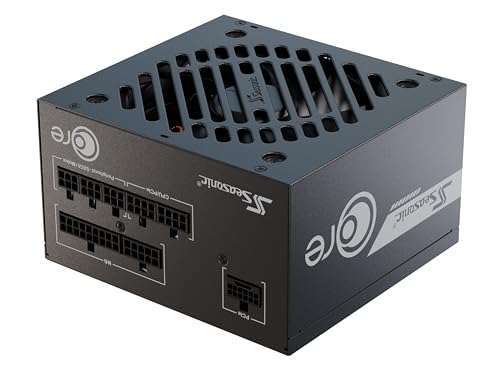
Specs
Rated output | 650W continuous |
Standard | ATX 3.1, PCIe 5.1 |
Efficiency | 80 Plus Gold |
GPU connector | Native 12V-2x6, plus a 2x 8-pin adapter |
Cabling | Fully modular |
Fan | 120mm hydro dynamic bearing |
Warranty | 7 years |
Rated output
650W continuous
Standard
ATX 3.1, PCIe 5.1
Efficiency
80 Plus Gold
GPU connector
Native 12V-2x6, plus a 2x 8-pin adapter
Cabling
Fully modular
Fan
120mm hydro dynamic bearing
Warranty
7 years
Which cards it covers
The RTX 5050, RTX 5060 and RTX 5060 Ti at every CPU tier, and the RTX 5070 beside a Ryzen 5, Ryzen 7, Core Ultra 5 or Core Ultra 7. It ships a native 12V-2x6 cable on a platform Seasonic builds itself. For a 5060 Ti specifically, our best PSU picks for the RTX 5060 Ti rank five units by build type.
Where it loses
Seasonic's CORE line sits below its Focus line, with seven years of warranty against ten. It also has no room for a 5070 Ti. If the budget is tighter, our budget PSUs that are still safe start at the same 650W tier.
750W tier pick: Corsair RM750x ATX 3.1

Specs
Wattage | 750W continuous |
Standard | ATX 3.1, PCIe 5.1 |
Efficiency | Cybenetics Gold |
GPU connector | Native 12V-2x6, 600W |
Cooling | 140mm FDB fan, zero-RPM mode |
Capacitors | 105C Japanese electrolytic |
Modularity | Fully modular |
Warranty | 10 years |
Wattage
750W continuous
Standard
ATX 3.1, PCIe 5.1
Efficiency
Cybenetics Gold
GPU connector
Native 12V-2x6, 600W
Cooling
140mm FDB fan, zero-RPM mode
Capacitors
105C Japanese electrolytic
Modularity
Fully modular
Warranty
10 years
Which cards it covers
A stock RTX 5070 Ti, an RTX 5080 beside a Ryzen 7 or Core Ultra 7 class chip, and an RTX 5070 paired with a Ryzen 9 or Core Ultra 9. The zero-RPM fan keeps it silent through light loads, and it carries ten years of warranty against seven on the 650W pick. Our 750W picks for RTX 5070 builds list four more units at the same wattage.
Where it loses
Under a 5060 or 5060 Ti it is capacity you will never touch. And an RTX 5080 with a 16-core Ryzen 9 or a Core Ultra 9 needs the next tier up, so buy for the CPU you own, not only the card.
850W tier pick: Corsair RM850x ATX 3.1
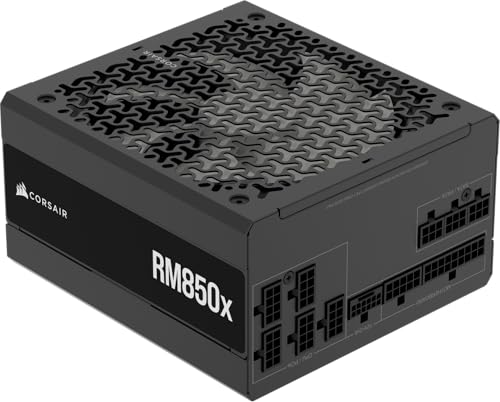
Specs
Wattage | 850W continuous |
Standard | ATX 3.1, PCIe 5.1 |
Efficiency | Cybenetics Gold |
GPU connector | Native 12V-2x6, 600W |
Cooling | 140mm FDB fan, zero-RPM mode |
Capacitors | 105C Japanese electrolytic |
Modularity | Fully modular |
Warranty | 10 years |
Wattage
850W continuous
Standard
ATX 3.1, PCIe 5.1
Efficiency
Cybenetics Gold
GPU connector
Native 12V-2x6, 600W
Cooling
140mm FDB fan, zero-RPM mode
Capacitors
105C Japanese electrolytic
Modularity
Fully modular
Warranty
10 years
Which cards it covers
An RTX 5080 with a Ryzen 9 or Core Ultra 9, an RTX 5070 Ti with a 16-core CPU, an overclock or a planned 5080 upgrade, and the one RTX 5090 build where 850W works: an ATX 3.1 unit beside a Ryzen 7 class chip with one or two drives. It is the same platform as the 750W pick with 100W more on the label.
Where it loses
For an RTX 5070 with a mainstream CPU it buys nothing you will measure. For an RTX 5090 it is the edge of what works, so a 360mm AIO, extra drives or a Ryzen 9 push that build to 1000W.
1000W tier pick: Corsair RM1000x ATX 3.1

Specs
Wattage | 1000 W continuous |
Standard | ATX 3.1, PCIe 5.1 |
Efficiency | Cybenetics Gold |
GPU connector | Native 12V-2x6, 600 W |
Cabling | Fully modular |
Transient headroom | 200% excursion per ATX 3.1 |
Warranty | 10 years |
Wattage
1000 W continuous
Standard
ATX 3.1, PCIe 5.1
Efficiency
Cybenetics Gold
GPU connector
Native 12V-2x6, 600 W
Cabling
Fully modular
Transient headroom
200% excursion per ATX 3.1
Warranty
10 years
Which cards it covers
The RTX 5090 with anything from a Ryzen 7 up to a Ryzen 9 9950X3D, air or AIO cooled, with two to four drives. It is the tier NVIDIA recommends for the card, and the one we would buy for most 5090 builds.
Where it loses
Below the 5090 it is overkill for every card in the chart. And a 5090 beside a Core Ultra 9 285K or an overclocked 9950X3D with a heavy drive and fan load leaves even 1000W thin. That build belongs at 1200W, and our RTX 5090 power supply guide covers the units at that tier.
Bottom line
If you have an RTX 5050, 5060 or 5060 Ti, a quality 550W unit you already own is usually enough, and 650W is the right buy if you are shopping. If you have an RTX 5070 with a mainstream CPU, buy 650W. If you have a 5070 Ti, or a 5080 beside a Ryzen 7 class chip, buy the Corsair RM750x. If your 5080 sits next to a Ryzen 9 or Core Ultra 9, buy 850W. If you have an RTX 5090, buy 1000W unless your parts list matches the narrow 850W case.
Whatever the tier, put the money into the quality of the unit before the number on the label. If your build mixes in a Radeon card, our PSU wattage guide for nine GeForce and Radeon tiers covers both brands, and our guide to choosing a power supply explains how to tell a good platform from a rebadge.
FAQ
What PSU wattage does each RTX 50 series card need?
Between 550W and 1000W, set by the card and then the CPU. A quality 650W ATX 3.1 unit covers the RTX 5050, 5060, 5060 Ti and a 5070 with a mainstream CPU. Buy 750W for a 5070 Ti or a 5080 beside a Ryzen 7, 850W for a 5080 with a Ryzen 9 or Core Ultra 9, and 1000W for an RTX 5090.
Is 650W enough for an RTX 5070?
Yes, with a mainstream CPU. NVIDIA recommends 650W for the RTX 5070, and a 250W card beside a Ryzen 7 9800X3D comes to about 467W at its worst-case ceiling, 72% of a 650W unit. Move to 750W for a Ryzen 9, a Core Ultra 9 or a Core i9-14900K, or if a 5070 Ti or 5080 is already planned. The Seasonic CORE GX-650 is the pick.
Is 750W enough for an RTX 5070 Ti?
Yes, for a stock card behind a Ryzen 7 or Core Ultra 7 class CPU, which matches NVIDIA's 750W recommendation. That build sits around 60% load on a quality unit during games. Buy 850W instead when the CPU is a 16-core part, when the card is overclocked behind a 360mm AIO and a full fan set, or when a 5080-class upgrade is already on the calendar.
Is 750W enough for an RTX 5080, or do I need 850W?
750W is enough beside a Ryzen 7 or Core Ultra 7 class chip, on an ATX 3.1 unit. That build's ceiling comes to about 577W, 77% of 750W. Buy 850W, which is NVIDIA's own figure, when the CPU is a Ryzen 9 9950X3D or Core Ultra 9 285K, or when the build carries four or more drives, a 360mm AIO and a full set of fans.
Is 1000W enough for an RTX 5090?
Yes, for most builds. NVIDIA recommends 1000W for the 575W card, and a quality ATX 3.1 1000W unit covers it beside anything from a Ryzen 7 to a Ryzen 9 9950X3D. A Core Ultra 9 285K or an overclocked 9950X3D with a heavy drive and fan load is the case for 1200W. An 850W unit works only on ATX 3.1 beside a Ryzen 7 class chip.
Is 650W enough for an RTX 5060 Ti?
Yes, at every CPU tier. The 5060 Ti is rated at 180W and NVIDIA recommends 600W for it. Even beside a 253W Core i9-14900K the system ceiling comes to about 490W, which is 75% of a 650W unit. A quality 550W unit is already enough with a Ryzen 5 or Ryzen 7, so 650W is the right size when you are buying new.
Do RTX 50 series cards need an ATX 3.1 power supply?
No card strictly requires one, but buy ATX 3.1 for any new build. NVIDIA recommends a PCIe CEM 5.1 compliant supply for every RTX 50 card. The real gain is the native 12V-2x6 cable, which replaces the multi-plug adapter from the RTX 5070 up and reports a plug that is not fully seated. On a 5060 or 5060 Ti a quality 8-pin unit works fine.
Is there an RTX 50 graphics card that doesn't need a power supply cable?
No. Every RTX 50 desktop card needs supplementary power from the PSU, down to the RTX 5050, which NVIDIA specifies with one 8-pin PCIe cable or a PCIe Gen 5 cable through its adapter. If your current supply has no PCIe power cable at all, it is not a gaming unit, and the right fix is a quality 650W ATX 3.1 supply.
Related Articles

Is 650W Enough for an RTX 5070? Yes, Except 2 Builds (2026)
Is a 650W PSU enough for an RTX 5070? Yes with a Ryzen 5, Ryzen 7 or Core Ultra 7. See the 2 builds that need 750W and the ATX 3.1 650W unit worth buying.
Nov 5, 2026

Is 750W Enough for a 5070 Ti, or Do You Need 850W? (2026)
Is 750W enough for an RTX 5070 Ti? For a stock card on a mainstream CPU, yes. Here is the real power draw, the transient spike data, and when 850W is worth it.
Aug 18, 2026

Is 750W Enough for an RTX 5080? Yes, Except 2 CPUs (2026)
Is 750W enough for an RTX 5080? Yes with a Ryzen 7 or Core Ultra 7 on an ATX 3.1 unit. A 9950X3D or 285K needs 850W. See the build table and the PSU to buy.
Nov 5, 2026

Is 850W Enough for an RTX 5090? Only on ATX 3.1 (2026)
Is 850W enough for an RTX 5090? Yes, but only on an ATX 3.1 unit beside a Ryzen 7 class CPU. Older 850W units trip on transient spikes. Both picks inside.
Sep 26, 2026

How Much PSU Wattage for a Gaming PC? 9 GPU Tiers (2026)
How much PSU wattage do you need? Sized floors for 9 GeForce and Radeon tiers, why 850W is usually overkill for gaming, and an ATX 3.1 pick at each tier.
Nov 5, 2026