Affiliate Disclosure: As an Amazon Associate we earn from qualifying purchases. Some links may earn us a commission at no cost to you.

Best PSU for RX 7800 XT (2026): 750W Sweet Spot, 5 Picks
The RX 7800 XT is rated at 263W of board power, and AMD asks for a 700W or larger power supply. The best PSU for an RX 7800 XT is a quality 750W ATX 3.1 unit: it clears that guidance with room for millisecond load spikes and a 65W to 125W CPU, and its fan idles through a typical gaming session.
Below are five units keyed to real build types, from a 650W floor for strict budgets to an 850W SFX unit for mini-ITX cases, plus the wattage math and the connector check that matters more than any badge on the box.
Our top pick: Corsair RM750x (2024)
The Corsair RM750x (2024) lands on the wattage this card wants, with a quiet fan curve, a CWT-built platform and a 10-year warranty.

Quick picks
Pick | Product | Best for | Buy |
|---|---|---|---|
Best Overall | Standard ATX builds, 65W to 125W CPUs | ||
Best Value | Price-per-watt buyers who want a long warranty | ||
Best Premium | 150W-plus CPUs and planned GPU upgrades | ||
Best Budget | Strict budgets, 65W CPUs, two-connector cards | ||
Editor's Pick | Mini-ITX and small-form-factor builds |
Best Overall
- Product
- Best for
Standard ATX builds, 65W to 125W CPUs
- Buy
Best Value
- Product
- Best for
Price-per-watt buyers who want a long warranty
- Buy
Best Premium
- Product
- Best for
150W-plus CPUs and planned GPU upgrades
- Buy
Best Budget
- Product
- Best for
Strict budgets, 65W CPUs, two-connector cards
- Buy
Editor's Pick
- Product
- Best for
Mini-ITX and small-form-factor builds
- Buy
Specs at a glance
Product | Wattage | Efficiency | Modularity | Form factor | Warranty |
|---|---|---|---|---|---|
750W | Cybenetics Gold | Fully modular | ATX | 10 years | |
750W | 80 Plus Gold, Cybenetics Platinum | Fully modular | ATX | 10 years | |
850W | 80 Plus Gold, Cybenetics Platinum | Fully modular | ATX | 10 years | |
650W | 80 Plus Bronze | Non-modular | ATX | 5 years | |
850W | 80 Plus Platinum | Fully modular | SFX | 7 years |
- Wattage
750W
- Efficiency
Cybenetics Gold
- Modularity
Fully modular
- Form factor
ATX
- Warranty
10 years
- Wattage
750W
- Efficiency
80 Plus Gold, Cybenetics Platinum
- Modularity
Fully modular
- Form factor
ATX
- Warranty
10 years
- Wattage
850W
- Efficiency
80 Plus Gold, Cybenetics Platinum
- Modularity
Fully modular
- Form factor
ATX
- Warranty
10 years
- Wattage
650W
- Efficiency
80 Plus Bronze
- Modularity
Non-modular
- Form factor
ATX
- Warranty
5 years
- Wattage
850W
- Efficiency
80 Plus Platinum
- Modularity
Fully modular
- Form factor
SFX
- Warranty
7 years
How we picked PSUs for the RX 7800 XT
Wattage tier | Verdict for an RX 7800 XT build |
|---|---|
650W | Works with a quality unit, a 65W-class CPU and a two-connector card. Thin margin under AMD's 700W guidance. |
750W | The sweet spot. Covers any mainstream CPU, absorbs load spikes, and runs near 60% load where fans stay slow. |
850W | For 150W-plus CPUs, three-connector overclocked cards, or a GPU upgrade inside two years. |
1000W and up | Over-buying for this card. Put the difference into the GPU or storage. |
650W
- Verdict for an RX 7800 XT build
Works with a quality unit, a 65W-class CPU and a two-connector card. Thin margin under AMD's 700W guidance.
750W
- Verdict for an RX 7800 XT build
The sweet spot. Covers any mainstream CPU, absorbs load spikes, and runs near 60% load where fans stay slow.
850W
- Verdict for an RX 7800 XT build
For 150W-plus CPUs, three-connector overclocked cards, or a GPU upgrade inside two years.
1000W and up
- Verdict for an RX 7800 XT build
Over-buying for this card. Put the difference into the GPU or storage.
Start with the card. A reference-style RX 7800 XT is rated at 263W, and factory-overclocked partner models run higher: the Sapphire Nitro+ is rated at 288W and adds a third 8-pin connector. Igor's Lab measured millisecond load peaks well above the rated figure, which is why a PSU's spike handling matters as much as its label.
Then add the rest of the system. A 65W-class CPU such as a Ryzen 7 7800X3D stays well under 100W in games, a Core i7 or Ryzen 9 can pull 150W or more, and drives, fans and USB devices add another 50W to 75W. That puts a typical 7800 XT build between roughly 400W and 500W at full gaming load, and the ledger above follows from it. Our PSU wattage guide runs the same math for other GPU tiers.
Connectors matter more than ATX 3.1 on this card. The 7800 XT uses classic PCIe 8-pin plugs, two on reference-style boards and three on some overclocked partner models, so count the PSU's 8-pin leads before you count its watts. ATX 3.1 still earns its place for its transient-load spec, and every pick here is an ATX 3.x design. The ATX 3.1 explainer covers what the standard changes.
Last, we filtered on who builds the unit. The PSU is the one part that can take every other part with it when it fails, so each pick comes from a platform we would sign off on in a finished build, and Corsair's CX, CV and VS budget lines stay out because they sit on a different OEM tier. For the full method, see how to choose a power supply.
Best Overall: Corsair RM750x (2024)
The default answer for a standard ATX build around this card.
Specs
Wattage | 750W |
Efficiency | Cybenetics Gold |
Standard | ATX 3.1, PCIe 5.1 |
Modularity | Fully modular |
GPU cables | PCIe 8-pin plus native 12V-2x6 |
Form factor | ATX |
Warranty | 10 years |
Wattage
750W
Efficiency
Cybenetics Gold
Standard
ATX 3.1, PCIe 5.1
Modularity
Fully modular
GPU cables
PCIe 8-pin plus native 12V-2x6
Form factor
ATX
Warranty
10 years
What it does well
At the 400W to 450W a 7800 XT system pulls in games, the RM750x runs near 60% load, where its 140mm fan spins slowly or stops and efficiency sits at its best.
The 2024 revision is built on a CWT platform that sits on our signed-build list, and it has the PCIe 8-pin capacity for a three-connector partner card without daisy-chaining. Full modularity keeps a mid-tower clean, and the 10-year warranty is the longest Corsair offers in this class.
What you give up
You pay more than the be quiet! value pick for the same 750W, and on this card the native 12V-2x6 cable stays in the box.
Older RMx stock from before the 2024 refresh still sells, and buyers have flagged mixed listings, so confirm the title says ATX 3.1 before you check out. If your CPU pulls 150W or more under load, the 850W Premium pick buys a more comfortable margin.
Who it's for
The builder pairing a 7800 XT with a 65W to 125W CPU in a normal ATX case, who wants one quiet unit that will also carry the next GPU. Still choosing the processor? Start with our CPU picks for the RX 7800 XT.
Best Value: be quiet! Pure Power 13 M 750W
The same 750W target with a ten-year warranty, usually for less.

Specs
Wattage | 750W |
Efficiency | 80 Plus Gold, Cybenetics Platinum |
Standard | ATX 3.1, PCIe 5.1 |
Modularity | Fully modular |
Fan | Semi-passive |
Form factor | ATX |
Warranty | 10 years |
Wattage
750W
Efficiency
80 Plus Gold, Cybenetics Platinum
Standard
ATX 3.1, PCIe 5.1
Modularity
Fully modular
Fan
Semi-passive
Form factor
ATX
Warranty
10 years
What it does well
be quiet! rates the Pure Power 13 M at 80 Plus Gold and Cybenetics Platinum, and its semi-passive fan keeps it silent at desktop loads and quiet under a 7800 XT gaming load.
It is ATX 3.1 and fully modular, and the ten-year warranty matches the top pick. For a card with a 263W rating, 750W of quality capacity covers any sensible CPU short of a high-draw Core i9.
What you give up
The trade-offs are cosmetic and small: plain black cables, no RGB, no digital monitoring.
The naming needs one careful look, because the older Pure Power 12 M still sells next to it and is a different platform. Reports suggest stock moves around between sale weekends, so if it is gone, the top pick is the like-for-like swap.
Who it's for
Price-per-watt buyers who still sort by warranty length, and anyone building a 7800 XT system on a mid-range budget. If the screen is next on your list, see our monitor picks for the RX 7800 XT.
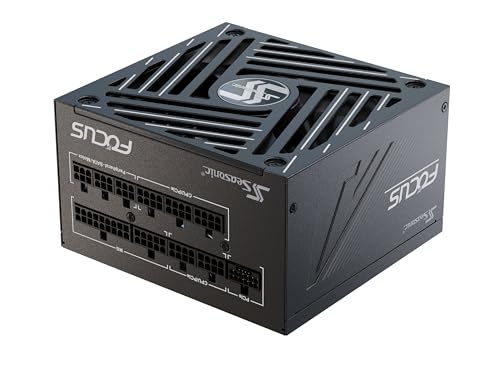
Best Premium: Seasonic Focus GX-850 (ATX 3.1)
850W from Seasonic's own factory, for high-draw CPUs and upgrade plans.
Specs
Wattage | 850W |
Efficiency | 80 Plus Gold, Cybenetics Platinum |
Standard | ATX 3.1, PCIe 5.1 |
Modularity | Fully modular |
Builder | Seasonic in-house |
Form factor | ATX |
Warranty | 10 years |
Wattage
850W
Efficiency
80 Plus Gold, Cybenetics Platinum
Standard
ATX 3.1, PCIe 5.1
Modularity
Fully modular
Builder
Seasonic in-house
Form factor
ATX
Warranty
10 years
What it does well
Seasonic builds the Focus GX in-house, and the ATX 3.1 revision is rated 80 Plus Gold and Cybenetics Platinum. Paired with a 7800 XT and a Core i7 or Ryzen 9, the unit sits near half load, the quiet middle of its fan curve.
The 850W ceiling also covers a step up to a 300W-class GPU later, and the ten-year warranty means this PSU can outlast two builds.
What you give up
With a 65W CPU it is more unit than this card needs, and the money is better spent on the GPU or storage.
The white version is a separate listing, so check the color before you buy. It is also a little longer than the 750W picks, which matters only in compact ATX cases with a bottom drive cage.
Who it's for
Owners of 150W-plus CPUs, overclockers, and anyone who expects to drop a bigger GPU into the same case within two years. For a wider 850W shortlist, see our RX 9070 PSU guide.
Best Budget: MSI MAG A650BN PCIE5 III
The floor: the cheapest unit we would put behind a 7800 XT, with conditions.

Specs
Wattage | 650W |
Efficiency | 80 Plus Bronze |
Standard | ATX 3.1, PCIe 5.1 |
Modularity | Non-modular |
GPU cables | 2x PCIe 6+2-pin plus 12V-2x6 |
Form factor | ATX |
Warranty | 5 years |
Wattage
650W
Efficiency
80 Plus Bronze
Standard
ATX 3.1, PCIe 5.1
Modularity
Non-modular
GPU cables
2x PCIe 6+2-pin plus 12V-2x6
Form factor
ATX
Warranty
5 years
What it does well
MSI's datasheet lists two PCIe 6+2-pin leads plus a 12V-2x6 cable, which matches the two-connector layout on reference-style 7800 XT cards. With a 65W-class CPU, a full system lands around 400W, so this ATX 3.1 unit still has margin for spikes.
MSI backs it with a five-year warranty, and it leaves more of the budget for the card itself.
What you give up
650W sits under AMD's 700W guidance, so this is a conditional pick: no 125W-plus CPU, no GPU overclock, and no three-connector card like the Sapphire Nitro+, which needs a third 8-pin lead this unit does not have.
Bronze efficiency and non-modular cables cost you a few watts at the wall and some cable-routing patience. If any of those conditions fail, step up to the Best Value pick. More options at this tier live in our budget PSU roundup.
Who it's for
Strict-budget builds pairing a reference-style 7800 XT with a Ryzen 5 or a 65W Ryzen 7, with no plans to upgrade the GPU.
Editor's Pick: Corsair SF850 (2024)
The SFX answer for a 7800 XT in a mini-ITX case.

Specs
Wattage | 850W |
Efficiency | 80 Plus Platinum |
Form factor | SFX (ATX bracket included) |
Modularity | Fully modular |
Fan | Zero RPM mode |
Warranty | 7 years |
Wattage
850W
Efficiency
80 Plus Platinum
Form factor
SFX (ATX bracket included)
Modularity
Fully modular
Fan
Zero RPM mode
Warranty
7 years
What it does well
Small cases need small power supplies, and the SF850 packs 850W and 80 Plus Platinum efficiency into the SFX format. At a 7800 XT system's load it runs near half capacity, so its small fan stays slow, and zero RPM mode switches it off at light loads.
An SFX-to-ATX bracket comes in the box, so the unit can move to a larger case later.
What you give up
SFX units cost more per watt than ATX ones, and the cables are cut short for small cases, which can be a stretch in a full tower.
Check the 7800 XT's length and slot width against the case before you buy, since many partner cards run long and thick for ITX. Fitment notes for popular cases are in our SFX PSU guide.
Who it's for
Mini-ITX builders putting a 7800 XT in a compact case who want enough headroom to keep a small fan quiet.
Bottom line
If you are building a standard ATX system around an RX 7800 XT, buy the Corsair RM750x (2024). If you want the same 750W with a ten-year warranty for less, buy the be quiet! Pure Power 13 M 750W. If your CPU pulls 150W or more or a GPU upgrade is coming, buy the Seasonic Focus GX-850. If every dollar has to go to the card and your CPU is a 65W part, the MSI MAG A650BN PCIE5 III is the floor. If the build is mini-ITX, buy the Corsair SF850 (2024).
FAQ
What wattage PSU do I need for an RX 7800 XT?
A quality 750W unit is the right target for most RX 7800 XT builds. The card is rated at 263W and AMD recommends 700W or more, a figure based on a high-draw Ryzen 9 system. With a typical 65W to 125W CPU, a full gaming system lands between roughly 400W and 500W, and 750W covers that with room for millisecond spikes while the PSU fan stays slow. Step up to 850W for a 150W-plus CPU or a planned GPU upgrade.
Is 650W enough for an RX 7800 XT?
Yes, with conditions. A quality 650W ATX 3.x unit runs a reference-style RX 7800 XT next to a 65W-class CPU such as a Ryzen 5 or a Ryzen 7 7800X3D. It sits under AMD's 700W guidance, so skip it with a 125W-plus CPU, a GPU overclock, or a three-connector card like the Sapphire Nitro+. Avoid no-name 650W units entirely, because the number on the label only means something on a unit built to deliver it.
Is 750W enough for an RX 7800 XT?
Yes. 750W is the sweet spot for an RX 7800 XT. It clears AMD's 700W recommendation, handles the card's brief load spikes, and has room for any mainstream CPU, including a Core i7 or a Ryzen 7 under gaming load. At a typical 400W to 450W system draw, a good 750W unit runs near 60% load, where it is efficient and quiet. Our top pick, the Corsair RM750x (2024), sits at this tier.
Does the RX 7800 XT need an ATX 3.1 power supply?
No. The RX 7800 XT uses classic PCIe 8-pin connectors, not 12V-2x6, so any quality PSU with enough 8-pin leads will power it. ATX 3.1 is still worth buying: the standard includes a spec for short power excursions, which is the load pattern modern GPUs produce, and it readies the unit for a 12V-2x6 card later. Every pick in this guide is an ATX 3.x design.
How many power connectors does the RX 7800 XT use?
Reference-style RX 7800 XT cards use two 8-pin PCIe connectors. Some factory-overclocked partner models add a third: the Sapphire Nitro+ uses three 8-pin plugs and carries a 288W rating. Run one separate PSU cable per connector where the PSU allows it rather than one daisy-chained cable, and confirm the PSU has enough 8-pin leads before you buy. The MSI budget pick has two, which limits it to two-connector cards.
Is an 850W PSU overkill for an RX 7800 XT?
For a 7800 XT with a 65W CPU, yes, 850W is more than the build needs. It is not wasted on every build: with a 150W-plus CPU such as a Core i7 or Ryzen 9, or with a GPU upgrade planned, 850W keeps the unit near half load and leaves room for the next card. In a mini-ITX case, an 850W SFX unit like the Corsair SF850 (2024) also keeps its small fan quieter.
Related Articles

How Much PSU Wattage for a Gaming PC? 9 GPU Tiers (2026)
How much PSU wattage do you need? Sized floors for 9 GeForce and Radeon tiers, why 850W is usually overkill for gaming, and an ATX 3.1 pick at each tier.
Sep 22, 2026

Best PSU for RX 9070 (2026): 750W or 850W? 5 Top Picks
The best PSU for an RX 9070 is 750W with ATX 3.1, or 850W with a high-end CPU. Its 220W TDP spikes to 830W, so transient response decides it, not wattage.
Aug 21, 2026

Best ATX 3.1 Power Supplies (2026): 5 Native 12V-2x6 Picks
Five ATX 3.1 power supplies with native 12V-2x6 connectors, Cybenetics Gold through Platinum, all 850W, plus how to spot an ATX 3.0 unit sold with an adapter.
Aug 14, 2026

Best CPU for Modern Warfare 4 (2026): 5 Picks by FPS Target
The best CPU for Modern Warfare 4 by FPS target: five picks from a budget AM5 chip to the 9800X3D for 240Hz lobbies, plus the AM4 drop-in upgrade path.
Oct 25, 2026

Are Dual-Mode Monitors Worth It? 4 Picks by Tier (2026)
Are dual-mode monitors worth it? At 27 inches, yes: the 1080p mode stays sharp. At 32 inches you pay halo money for 69 PPI. Four picks, one for each tier.
Oct 25, 2026