Affiliate Disclosure: As an Amazon Associate we earn from qualifying purchases. Some links may earn us a commission at no cost to you.

Do You Need an X3D CPU for Gaming? 2026 Buyer's Verdict
Short answer: probably not. If you game at 1440p or 4K on anything short of a flagship graphics card, a non-X3D Ryzen puts the same frames on screen as an X3D chip, and the cache premium is money your GPU would have used better.
Two things flip that. Your library, if it leans on sims, strategy, MMOs, or Escape from Tarkov. And your graphics card, if it is fast enough that the processor becomes the next limit. Below is the test for both, then three AM5 picks: the chip that is enough, the cheaper floor under it, and the one worth spending up for.
At a glance
Pick | Cores and cache | Best for | Buy |
|---|---|---|---|
8C / 16T, 32 MB L3 | The default answer at 1440p and 4K | ||
6C / 12T, 32 MB L3 | Tight budgets where the GPU needs the money | ||
8C / 16T, 96 MB L3 | Sims, strategy, MMOs, and 1080p frame chasing |
- Cores and cache
8C / 16T, 32 MB L3
- Best for
The default answer at 1440p and 4K
- Buy
- Cores and cache
6C / 12T, 32 MB L3
- Best for
Tight budgets where the GPU needs the money
- Buy
- Cores and cache
8C / 16T, 96 MB L3
- Best for
Sims, strategy, MMOs, and 1080p frame chasing
- Buy
Is a non-X3D Ryzen enough for you?
Your setup | What limits you first | Verdict | Winner |
|---|---|---|---|
1440p or 4K with a mid-range GPU | The graphics card, in nearly every title | Non-X3D is enough | |
1080p high refresh with a budget GPU | Still the graphics card, not the cache | Non-X3D is enough | |
A console-port AAA library at 1440p or above | The engine, not the cache | Non-X3D is enough | |
Sims, strategy, MMOs, or Tarkov at any resolution | The simulation working set, not the GPU | Spend up | |
1440p with a flagship GPU | The processor, and it shows in 1% lows | Spend up | |
1080p at 360 Hz with a top-tier GPU | The frame ceiling is cache-pinned | Spend up |
1440p or 4K with a mid-range GPU
- What limits you first
The graphics card, in nearly every title
- Verdict
Non-X3D is enough
- Winner
1080p high refresh with a budget GPU
- What limits you first
Still the graphics card, not the cache
- Verdict
Non-X3D is enough
- Winner
A console-port AAA library at 1440p or above
- What limits you first
The engine, not the cache
- Verdict
Non-X3D is enough
- Winner
Sims, strategy, MMOs, or Tarkov at any resolution
- What limits you first
The simulation working set, not the GPU
- Verdict
Spend up
- Winner
1440p with a flagship GPU
- What limits you first
The processor, and it shows in 1% lows
- Verdict
Spend up
- Winner
1080p at 360 Hz with a top-tier GPU
- What limits you first
The frame ceiling is cache-pinned
- Verdict
Spend up
- Winner
Benchmarks
Crowd-heavy driving is the CPU-sensitive part of this game, and the three chips land within a handful of frames.
- 95 FPS
- 90 FPS
- 85 FPS
One of the wider non-cache gaps in this suite, and it still shrinks every step up in resolution.
- 155 FPS
- 140 FPS
- 135 FPS
All three clear any mainstream high-refresh monitor here.
- 210 FPS
- 195 FPS
- 185 FPS
The console-port case. The cache wins nothing at all.
- 120 FPS
- 120 FPS
- 118 FPS
Those four are the ordinary case, and the ordinary case is undramatic. At 1080p on a graphics card most people do not own, the spread across all three chips is small. Move to 1440p on a mid-range card and it stops being measurable at all.
The cache-sensitive case looks nothing like that. In Counter-Strike 2, Flight Simulator 2024, and late-game Total War battles, reviewer testing puts the 9800X3D roughly 15 to 30 percent ahead of non-X3D Zen 5 chips in averages, and the gap in 1% lows is wider still. Baldur's Gate 3 behaves the same way once you reach the Lower City in Act 3. Notice what those titles share: a large world state that has to be touched every frame. If it fits in cache, it is fast. If it does not, it is a trip to memory. For a chip-by-chip breakdown of that split, the chip-by-chip X3D comparison covers it in more depth.
How to tell which side you are on
Three inputs decide this, and you already have all three: your graphics card, your monitor, and the games you open most.
Start with the graphics card, because it sets the ceiling. I lock the GPU first on every build I spec, then size the processor so it does not bottleneck that card at the target resolution, and no further. At 1440p with a mid-range card, a six-core Zen 5 chip is not your limit. The card is. Swapping in an X3D processor there moves the frame counter by a rounding error, which is the same reason choosing a CPU and motherboard together starts with what the GPU needs.
Then the monitor, and be honest about it. The first question I ask any buyer is what one game they play the most and on what panel, because people say 4K reflexively and then admit they own a 1080p 75 Hz screen. Buying way up on the processor for an esports library on a 240 Hz 1080p panel is the classic version of this. That buyer does not need an X3D chip. They need the graphics card they were about to skimp on.
Now the library test, which is the one that flips the answer. Sim racing, flight sim, strategy and 4X and city builders, MMOs in dense content, factory and colony sims at scale, and Escape from Tarkov all keep a large world resident and re-touch it constantly. So does streaming and gaming on one box. If your hours live there, the cache is doing real work and you should buy it. Sim racing in VR is the extreme version, and the sim racing CPU picks lean X3D top to bottom for exactly this reason.
One reason this argument gets muddled is that averages hide the part you feel. A cache-bound game can post a respectable average frame rate and still hitch every time the simulation grows: a Total War battle late in a campaign, an approach into a dense airport, a raid boss with forty players on screen. That is a 1% low problem, and it is where the cache gap is widest. If your games do that to you today, the numbers in a suite average will understate how much an X3D chip helps.
The other list is longer than most buyers expect. AAA at 4K on a mid-range card. A console-port library at 1440p and above, where well-optimized engines make the chips look identical in real play. A 240 Hz panel fed by a budget card that cannot get anywhere near it. And the buyer who wants the machine to last a decade, whose money does more in the graphics card, memory, and storage than in cache.
One more thing that takes the pressure off this decision. AM5 has committed support past 2027, so it is reversible. Start on a non-X3D chip, and if your library drifts toward simulation in two years, the X3D part drops into the same socket after a BIOS update.
Enough for most builds: AMD Ryzen 7 9700X

Specs
Cores / threads | 8 / 16 |
Boost clock | 5.5 GHz |
Base clock | 3.8 GHz |
L3 cache | 32 MB |
TDP | 65 W (105 W mode selectable) |
Socket | AM5 |
Memory support | DDR5-5600 (EXPO to 6000 CL30) |
Cooler included | No |
Cores / threads
8 / 16
Boost clock
5.5 GHz
Base clock
3.8 GHz
L3 cache
32 MB
TDP
65 W (105 W mode selectable)
Socket
AM5
Memory support
DDR5-5600 (EXPO to 6000 CL30)
Cooler included
No
What it does well
Eight Zen 5 cores at a 65 W default is the point where the processor stops being the thing holding a build back. In engine-limited AAA and console-port titles the 9700X sits within a few percent of the 9800X3D at 1080p, and the gap closes further with every step up in resolution. By 1440p on a mid-range card you are measuring the graphics card, not the chip, which is why it shows up across the 1440p CPU picks by tier.
The thermal envelope matters more than the spec sheet suggests. At 65 W a mid-tier tower cooler keeps this chip quiet under sustained load. No pump, no year-four failure risk, and the cooling line item stays small enough that the savings survive into the parts that change what you see.
Two cores over the 9600X buy real headroom for how people actually play: a game, a browser with a dozen tabs, Discord, and a capture overlay all at once. The socket stays open too, so nothing about this pick closes a door.
What you give up
Cache-bound games. The 9700X loses to the 9800X3D in simulation-heavy titles, and it loses in 1% lows more than in averages, which is the half of the frame graph you feel rather than the half you screenshot. A late-game Total War battle or a dense airport approach in Flight Simulator 2024 stutters in ways an average frame rate hides.
It is also not the chip for a frame-ceiling chase. If the goal is feeding a 360 Hz panel in Counter-Strike 2, the cache is doing the work up there, and this chip does not have it.
Who it's for
The 1440p or 4K builder on a mid-range to upper-mid graphics card with a library that is mostly AAA, action, and shooters. If that describes you, this is the chip, and the difference belongs in the graphics card.
The budget floor: AMD Ryzen 5 9600X

Specs
Cores / threads | 6 / 12 |
Boost clock | 5.4 GHz |
Base clock | 3.9 GHz |
L3 cache | 32 MB |
TDP | 65 W |
Socket | AM5 |
Memory support | DDR5-5600 (EXPO to 6000 CL30) |
Cooler included | No |
Cores / threads
6 / 12
Boost clock
5.4 GHz
Base clock
3.9 GHz
L3 cache
32 MB
TDP
65 W
Socket
AM5
Memory support
DDR5-5600 (EXPO to 6000 CL30)
Cooler included
No
What it does well
Six Zen 5 cores track the 9700X closely in games, because at any sane resolution both chips are waiting on the graphics card. Same 65 W envelope, same AM5 socket, same DDR5-6000 CL30 sweet spot the platform wants.
What it really buys is a graphics tier. On a build in the low four figures, the difference between this chip and an X3D part is not a small optimization. It is the gap between two graphics cards, and the graphics card is the part you feel every time you sit down.
It is current-generation as well, so the upgrade path stays live rather than ending on a socket that is already closing.
What you give up
Six cores strain under a game plus a broadcast plus heavy background work. If you genuinely record or stream rather than just intending to, step up a tier.
It carries the same 32 MB cache as the 9700X with fewer cores to absorb the load, so in simulation-heavy titles it sits at the bottom of this group. That is fine if your hours are not there and painful if they are.
Who it's for
The tight-budget builder at 1080p or 1440p on a mid-range card. Reaching for an X3D chip in this build and then buying whatever graphics card is left over is the single most common processor mistake at this tier, and it produces identical frames.
Spend the difference on the graphics card first, then on a 32 GB DDR5-6000 CL30 kit, which is the most asymmetric upgrade left on this platform. Both will change what you see. The cache, in this build, will not.
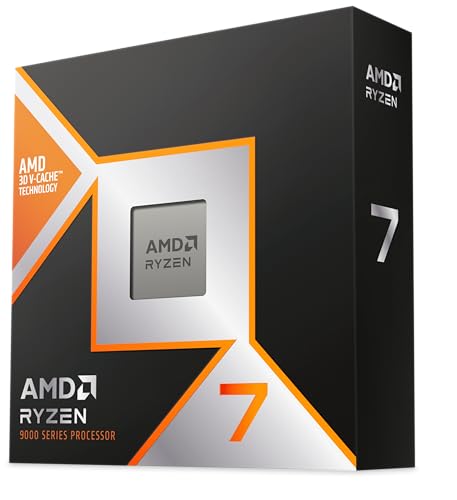
The step up: AMD Ryzen 7 9800X3D
Specs
Cores / threads | 8 / 16 |
Boost clock | 5.2 GHz |
Base clock | 4.7 GHz |
L3 cache | 96 MB (64 MB 3D V-Cache) |
TDP | 120 W |
Socket | AM5 |
Overclocking | Fully unlocked |
Memory support | DDR5-5600 (EXPO to 6000 CL30) |
Cores / threads
8 / 16
Boost clock
5.2 GHz
Base clock
4.7 GHz
L3 cache
96 MB (64 MB 3D V-Cache)
TDP
120 W
Socket
AM5
Overclocking
Fully unlocked
Memory support
DDR5-5600 (EXPO to 6000 CL30)
What it does well
96 MB of L3 cache is the entire argument. When a game keeps a large world resident and touches it every frame, the difference between reading from cache and reading from memory shows up as frames. That is why sim racing, flight sim, late-game strategy, dense MMO content, and Escape from Tarkov separate this chip from non-X3D Zen 5 by roughly 15 to 30 percent in reviewer testing, with a wider gap in 1% lows.
It is also the chip for the frame-ceiling chase. Counter-Strike 2 above roughly 500 fps is cache-pinned rather than clock-pinned, so the 96 MB pool keeps the working set close while a non-X3D chip refetches it. That only pays if you already own the monitor and the graphics card to use those frames.
Feed it properly. AM5 rewards a 1:1 fabric ratio, so the DDR5 pairing for the 9800X3D is not a footnote; skimping on memory gives back part of what the cache just bought.
What you give up
A real premium, and a 120 W envelope against 65 W on both non-X3D picks, which quietly pushes the cooler budget up. Reports also put its peak boost below the 9700X at 5.2 GHz against 5.5 GHz, so lightly threaded work that does not lean on cache can land in the cheaper chip's favor.
And in a console-port AAA library at 1440p and above, it buys frames nobody will ever see. That is the honest version of the trade, laid out in full in the 9700X and 9800X3D head to head.
Who it's for
Sim, strategy, and MMO players at any resolution, plus 1440p and 1080p builders already running a flagship card where the processor is genuinely the next limit. If you are still weighing whether your library qualifies, whether the 9800X3D earns its price goes deeper on that question.
Bottom line
If you play AAA and shooters at 1440p or 4K on a mid-range card, buy the AMD Ryzen 7 9700X and move the difference into the graphics card.
If the budget is tight and the GPU needs the money, the AMD Ryzen 5 9600X gives up almost nothing in games.
If your hours live in sims, strategy, MMOs, or Tarkov, buy the AMD Ryzen 7 9800X3D and stop second-guessing it. The same answer holds if you already own a flagship card and game at 1440p.
And if you are shopping the previous generation, the older 7800X3D still holds up for cache-heavy libraries at a lower entry point.
FAQ
Is an X3D CPU worth it at 1440p or 4K?
For most builds, no. At 1440p and above the graphics card sets the frame rate in the overwhelming majority of titles, so a non-X3D Ryzen produces the same numbers as an X3D chip. The exception is a flagship graphics card paired with a cache-heavy library, where the processor becomes the next limit and 1% lows start to separate. Check the card first. If it is mid-range, buy the 9700X or the 9600X and put the difference into the GPU.
Does 3D V-Cache help in all games or just some?
Just some, and the split is predictable. Games that keep a large world resident and touch it every frame benefit: sim racing, flight sim, late-game strategy, dense MMO content, factory and colony sims, and Escape from Tarkov. Games that are engine-limited or GPU-limited barely move, which covers most console-port AAA. Red Dead Redemption 2 is the clean example, where all three chips in this guide land on top of each other at 1080p.
How much FPS difference is there between X3D and regular Ryzen?
It depends entirely on the title. In cache-sensitive games, reviewer testing puts the 9800X3D roughly 15 to 30 percent ahead of non-X3D Zen 5 in averages, with a wider gap in 1% lows. In engine-limited AAA at 1080p the gap is usually a handful of frames, and at 1440p on a mid-range card it collapses to nothing you can see. Suite-wide averages land in the middle, which is why they are a poor way to decide this.
Do you need an X3D CPU if you have a mid-range GPU?
No. A mid-range card runs out of headroom long before the processor does, so the cache sits idle and the money buys frames you cannot render. This is the most common version of the mistake: spending up on the chip and then pairing it with whatever graphics card the budget has left. Buy the 9700X or the 9600X, push the savings into the GPU, and you will notice the difference every session.
Is the Ryzen 7 9700X enough for gaming in 2026?
Yes, for the large majority of gaming builds. Eight Zen 5 cores at 65 W stay within a few percent of the 9800X3D in engine-limited titles at 1080p, and the gap narrows again at 1440p and 4K. It has the headroom for a game plus a browser, Discord, and an overlay. The buyers who should look past it are sim, strategy, and MMO players, and anyone chasing a very high frame ceiling with a flagship card already installed.
Can you add an X3D chip later on the same AM5 board?
Usually yes, and that is a real reason not to agonize over the decision now. AM5 has committed support past 2027, and X3D parts drop into the same socket. You will want a BIOS update for a newer chip and a board whose VRM suits it, but the physical swap is a screwdriver job. Starting on a non-X3D processor and upgrading if your library shifts toward simulation is a legitimate plan, not a consolation prize.
Related Articles

X3D vs Non-X3D for Gaming (2026): 3 Picks by Player Type
X3D vs non-X3D for gaming: which Ryzen earns the cache premium. One pick each for esports, AAA at 1440p/4K, and sim or strategy, plus when to skip X3D.
Sep 8, 2026

Ryzen 7 9700X Vs 9800X3D (2026): 8 Games, 6 Buyer Profiles
Ryzen 7 9700X vs 9800X3D in 2026: 8 game benchmarks and 6 buyer profiles show when the X3D cache pays back, and when the 9700X plus a better GPU wins instead.
Aug 24, 2026

Is the Ryzen 7 9800X3D Worth It in 2026? Buy or Skip
Buy the Ryzen 7 9800X3D for 360Hz shooters, sim racing and heavy strategy. Skip it at 1440p on a mid-tier GPU. Full 2026 verdict vs the 9600X and 9850X3D.
Aug 26, 2026

Best CPUs for 1440p Gaming (2026): Five Top Picks Ranked
Best CPUs for 1440p gaming in 2026, picked by GPU pairing and library. Honest answer on whether the 9800X3D is overkill, and when the 9700X or 265K wins.
May 20, 2026

How to Choose a CPU and Motherboard
The buyer's framework for picking a CPU and motherboard pair: use case first, socket second, chip tier third, then the board class that matches.
May 17, 2026